New on SocTakes: Illustrated history of MLS crests: Part I

MLS crests
Image credit: MLS

With Chicago’s recent rebrand announcement receiving a, shall we say, openly hostile reception, we’ve gotten to talking about soccer logos in the Soc Takes group chat. It’s a common pastime for us, much like any other members of #SoccerTwitter, and this got me thinking about the various brands and rebrands we’ve seen in MLS since its inception in the mid-’90s. MLS itself has gone through a handful of different logos in its history, before settling on the current design in 2014.

For this mini-series, we’ll be going through MLS teams in a quasi-chronological order, starting with the original Class of 1996, continuing with the teams launched between 1997 and 2010, onto the latest batch of expansion that began with New York City and Orlando in 2013, and wrapping up by looking at the latest logos to be revealed for the teams yet to enter MLS.

Illustrated history of MLS crests

Major League Soccer

1994

We begin back in 1994. The World Cup had finally come to the United States, and with it, the requirement from FIFA for a top level professional league. As excellently documented by Beau Dure in his book “Long Range Goals,” MLS won the bidding by USSF to become that league, and launched in 1994 with 10 teams ready to go, and another two just a few years away. The league adopted a logo inspired by those of the NBA and MLB, with a red, white and blue color scheme and a relevant athletic silhouette, but this logo would be scrapped before the announcement of the inaugural 10 teams.

1995-99

MLS instead adopted a unique blue and green palette, a simple color swap of the original logo, setting the tone for their branding for the next two decades. This was the logo used at the public reveal of the founding markets and teams, and was carried over for the league’s first three seasons. While MLS was originally slated to kick off in 1995, a few operational delays forced the start back one year, with the league deciding that it was better to have a well-organized, well-prepared launch than to rush into things.

2000-07

For the 2000 season, much like nearly every major brand on the planet, MLS updated its logo for the Information Age™, adding more detail and shading to the boot and ball along with a thick black outline. An alternate logo, missing the “MAJOR LEAGUE SOCCER” wordmark, was also used, particularly online and in graphics. This fundamental design would prove to be the longest lasting branding used by the league.

2008-14

The next revision was even subtler, simply adopting the previous alternate logo as the league’s new primary branding, carrying over the same fundamental idea for another seven seasons.

2015-Present

In September 2014, MLS unveiled a complete redesign of all its branding, adopting a new primary crest and numerous palette-swapped variants, with one for each member club. The new logo also launched the wonderful trend of PR-speak branding guidelines, stating that the three stars stood for club, country and community, and the upward sloping line representing MLS’ pathway into the future. Onward and upward, literally.

Colorado Rapids

1996-99

The Colorado Rapids launched with a very ’90s brown and blue color scheme, and a logo that more resembled a minor league baseball team than professional soccer. This would end up being among the longest-lived brandings for the original 10 teams, with only New England’s controversial flag and Columbus’s hard hat trio lasting longer.

2000-07

For 2000, the Rapids made some subtle tweaks to their colors, settling on new shades of gold and blue. They also began to make more frequent use of a roundel secondary crest, though it was never considered a primary brand.

2007-Present

Colorado’s only substantial overhaul settled on their still-active primary brand in 2007, adopting a completely new color palette inspired by the other Kroenke-owned Denver-area sports teams, and brought the Rapids more in line with conventional soccer aesthetics.

Columbus Crew

1996-2014

Much has been said about the Crew’s original logo. References to The Village People, attempts to identify the three men pictured, the adoption of hard hats as fan ware, you name it. It never featured the city in which the Crew played, and even referred to them by “the Crew.” Peak 1990s aesthetic.

2014-Present

Considered by me to be the only positive lasting contribution made by former investor-operator Anthony Precourt, Columbus adopted a roundel design in 2014 as the first major change to their visual identity. Also changed were the shades of black and gold, with a much brighter yellow made the primary color and the shade of black set as a very dark shade of grey. It’s honestly still one of my favorite logos in MLS, and there’s a reason that the new owners haven’t touched it.

Dallas Burn/FC Dallas

1996-2004

“OK guys, we’ve got to figure out the branding for this new Dallas team. What’s iconic about Dallas?”
“Well, they ride a lot of horses in Texas, right? How about something with a horse?”
“Genius! But it’s 1995, baby, we need to be modern! Hip! Edgy! With it!”
“Well, it’s hot as hell in Texas, so what about the Burn? Because stuff that burns is really hot! And maybe the horse is breathing fire!”
“Perfection! You’re getting a raise, kid. No, a promotion!”

2005-Present

By the summer of 2004, the Burn had broken ground on a new stadium in the suburb of Frisco, and as part of the move to their own purpose-built home, the team completely rebranded. Gone was the name, Burn, and with it, the fire-breathing horse. Dallas needed something that screamed soccer, and Texas, and what better than to simply call the team FC Dallas and feature a Texas Longhorn cow on a red, white and blue shield? While the logo received a lukewarm reception in 2004, it’s proven decent enough and still holds up alongside the latest and greatest offerings from around the league.

Fun fact, the team has never settled on standard shades of red or blue.

D.C. United

1996-97

D.C. United’s original logo drew immediate comparisons to totalitarian symbolism. There’s nothing wrong with using an eagle as a prominent symbol, but the way they went about it felt more-than-vaguely fascist. Apparently, the criticism worked, because after just two seasons, D.C. gave it another go.

1998-2015

Ah, much better. While the general idea remained the same, D.C. opted for a much more American take on an eagle motif, and adjusted the crest’s shape and typography to look a good bit cleaner. This would end up lasting almost as long as RFK Stadium, and D.C. won the bulk of their trophies with this crest on their jerseys.

2016-Present

As ground broke on D.C.’s forever home, the team once again changed hands, and decided to update their crest as it entered a new era. The basic idea of the eagle with outspread wings stayed, but with a much more modern design, a brand new and really rather lovely typeface, and a nod to the District’s amazing flag across the eagle’s body. As far as I’m concerned, they nailed it here.

Kansas City Wiz/Wizards/Sporting KC

1996

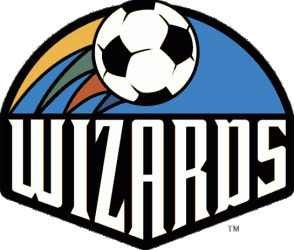
This was Kansas City’s actual name and logo at their launch, straight out of a Zima-fueled bender in 1995. It’s amazingly terrible, and I unironically ironically love it. Soon after the team’s debut, there was a bit of a friendly rivalry with their neighbors to the south, with plenty of definitely subtle references to sexually transmitted diseases. Wiz vs Burn, anyone?
MLS crests
1997-2006

Kansas City lengthened Wiz to Wizards for their sophomore season, thanks in no small part to threats from the now-defunct “The Wiz” electronics chain, and stuck with it for over a decade. The uber-vivid colors were muted a touch, but the flashy magic rainbow aesthetics remained core to the team’s visual identity well into the 2000s. I still can’t believe that this actually happened.

2007-10

In 2007, as MLS entered the Beckham era, Kansas City decided they needed to update their branding as well, but rather than ditching the delightfully absurd Wizards moniker, they merely de-rainbow-fied themselves. This would last a few seasons longer than the original Wiz idea, coinciding with the team’s move from the colossal Arrowhead Stadium to an independent league ballpark in the suburbs.

MLS crests
2011-Present

Fortunately, Kansas City was sold to committed and savvy new investors in 2007 who had big plans for the team. A new stadium, a new name and, of course, a new logo. They chose Sporting Kansas City, initially as part of a united “Sporting Club” that ultimately never came to fruition, but gave the team a fantastic logo that still ranks among the best in MLS.

LA Galaxy

MLS crests
1996-2002

What the hell were people doing in the ’90s, honestly? I get the idea of Galaxy for Los Angeles, it’s a cluster of stars, and the spiral galaxy motif makes some logical sense, but the Galaxy were one of the more aggressively ’90s-tinted teams. This design would actually last for over a decade with only a minor adjustment to the colors.

MLS crests
2003-06

They actually managed to take their goofy design and make it worse, with a less attractive shade of green. Fortunately, they soon figured things out, decided to act like a big-time LA team, and made a few changes that would define the team for the next decade and change.

MLS crests
2007-Present

How do you achieve relevance in a crowded, competitive and often fickle sports market? For the Galaxy, they built a new stadium, signed David Beckham and Robbie Keane, and adopted a logo that was in no way derivative of Real Madrid. Long before adopting this crest, LA had made the diagonal sash their look, and with the bright new logo and color scheme, the white and blue came to symbolize success and fame in MLS.

New England Revolution

MLS crests
1996-Present

There are times where a team gets their branding right the first time, and never needs to change a thing. This is not one of those times. Even back in 1996, New England’s logo was mocked, likening it to a crayon drawing. Little has changed on either side, with the team merely adding/removing the wordmarks as needed and slightly tweaking the palette, and the fans and pundits continue to point out how bad it looks. Team leadership has said that they’ll rebrand when they open a stadium of their own, but even that’s been in development hell for over a decade. We’ll see if they ever actually do either.

New York/New Jersey MetroStars/MetroStars/New York Red Bulls

1996-97

Would a team by any other name still get acknowledged as playing in New York City? Apparently not, but they still tried. The New York/New Jersey MetroStars, slash and all, were the original NYC representatives in MLS, featuring a name inspired by the team’s original owners, Metromedia. When people point out that they’re so blatant about their corporate ownership, just point to that fact and say it’s always been like this.

MLS crests
1998-2005

Oddly enough, though, the MetroStars name resonated with fans, and even after dropping any geographic marker in the name, the MetroStars brand lasted quite a while. A vocal minority even prefer this era’s branding to the current Red Bulls era. And for any Atlanta fans reading this, the MetroStars were the original Five Stripes, red, black, gold and everything.

2006-07

Can you guess who bought the team in 2006? I’ll give you three hints. They’re a major energy drink company based in Austria, they’re inspired by a famous Thai energy drink named after a crimson cow and they’re well known for their involvement in the more “extreme” side of sports.

Red Bull were unbelievably blatant and coarse with their changes after taking control, completely erasing the MetroStars history, and stamping their corporate logo on everything, much to the chagrin of longtime fans.

MLS crests
2008-Present

When Red Bull updated their corporate imagery in 2008, they applied it to their various sports properties, RBNY included. The updated logo toned down the “extremeness” of the bulls, simplified the sun design in the center, and darkened the color palette. This same branding would be applied to the team’s new stadium, to be known as Red Bull Arena.

That said, there’s been some talk of Red Bull selling the stadium and/or team in the near-enough future, so maybe this logo won’t be around in a few seasons.

San Jose Clash/Earthquakes
MLS crests
1996-99

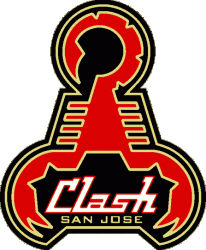
Part of the inspiration behind the launch of MLS was a step away from the mistakes of the NASL. The league made a concrete effort to avoid reusing branding and to make it crystal clear that they weren’t going to be a repeat of the past. This meant that the iconic San Jose Earthquakes name was passed over in favor of a new idea, which for some reason involved scorpions. I don’t know, blame Nike.

NASL-era Earthquakes
San Francisco Bay Blackhawks

Another idea proposed by the team’s original owner was a continuation of the San Francisco Bay Blackhawks, a team founded in 1989 following the folding of the original Earthquakes. The Blackhawks became one of the rare powerhouse teams of the late ’80s and early ’90s, producing a number of USMNT players and notably advanced into the second stage of the 1992 CONCACAF Champions Cup, before falling 4-3 to Club America. Unfortunately, Blackhawks/Clash owner Dan Van Voorhis had some financial and legal trouble that saw him hand his MLS team back to the league before the league officially launched.
2000-04

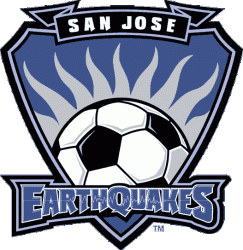
In 2000, with the team under control of the former owner of the NASL Earthquakes, the Earthquakes name was revived with a new blue, black and white scheme. This proved to be much more popular with fans, both those who remembered the original team and newer fans who hated the Clash branding. The team quickly went on a tear, winning two MLS Cups with the new name and logo.

2005

The Earthquakes logo received a fresh coat of hex color codes for 2005 and proceeded to storm to their first Supporters’ Shield, but off the field, owners AEG had other ideas. At the end of another successful season, the team packed its bags and moved to Houston, with the promise that MLS would return to San Jose in a few years once the situation was better.

MLS crests
2008-13

Following two seasons where the former Earthquakes won two championships in a different city, MLS brought the Earthquakes back from the dead with new owners, a new home and new logo. These revived Earthquakes won another Supporters’ Shield and saw the rise of Chris Wondolowski as the face of the new era, alongside plans for a proper stadium for the future.

MLS crests
2014-Present

As the Earthquakes broke ground, at long last, on their new dedicated stadium, the team followed in the footing of recent MLS trends and rebranded to mark a new era. Strangely, the name Earthquakes was abbreviated to simply Quakes, even though a matching EarthQuakes wordmark was created and has been used by the team. The new crest received a lukewarm reception, mainly stemming from the abbreviation, but has lasted through six seasons and revived interest in the team.

Tampa Bay Mutiny

MLS crests
1996-2001

MLS owned and operated the Tampa Bay Mutiny for all six seasons of the team’s existence, all under an unusual video game and sci-fi-inspired crest featuring some strange mutant alien creature that Nike claimed would control the ball with its mind. Sadly, the team’s move to Raymond James Stadium in 1998 came with a rather horrid lease, and attempts to convince Malcolm Glazer to buy the team failed, with him instead deciding to buy a community team in northern England, and MLS decided after the 2001 season to fold both Florida teams.


This concludes Part I of this comprehensive look at the history of MLS crests and branding. Part II picks up where we left off with the two expansion teams from 1998, and continues through the teams announced by 2011. Part III will then begin with New York City FC and Orlando City SC, and continue through the present.

As always, a massive tip of the hat goes to Chris Creamer and SportsLogos.net, one of my favorite resources for sports design history. If you’re at all curious about the history of branding in sports — and judging by the fact you read this far, you are — go check the site out.

And if you like this sort of stuff, check out a piece that inspired the escalation of my original commentary on the Fire’s new branding, written by Buzz Carrick over at 3rdDegree.net two years ago.

Follow John on Twitter: @JohnMLTX.

Support Soc Takes on Patreon for access to exclusive content and supporter benefits. Click here to become a patron today.

The post Illustrated history of MLS crests: Part I appeared first on Soc Takes.

from Soc Takes https://ift.tt/38uuRfH
via IFTTT

New on SocTakes: Front Porch Discourse: How did FC Cincinnati get it so wrong?

In the latest episode of Front Porch Discourse, co-hosts John Lenard and Ian Foster discuss the pitfalls of FC Cincinnati‘s expansion season, comparing them to the decade’s other lower-leagues-to-MLS transitions. But first, they take on how the media seemed to completely underestimate Jill Ellis and the USWNT in 2019.

Follow Front Porch Discourse on Twitter: @FPDiscourse.

Support Soc Takes on Patreon for access to exclusive content and supporter benefits. Click here to become a patron today.

The post Front Porch Discourse: How did FC Cincinnati get it so wrong? appeared first on Soc Takes.

from Soc Takes https://ift.tt/35zS7YJ
via IFTTT

New on SocTakes: Rethinking Open Cup format

Open Cup format
Things get testy between the Indy Eleven and Lansing Ignite FC in the 2019 U.S. Open Cup. Photo credit: Robbie Mehling/Soc Takes

Well hello there, Soc Takes. It’s been a while.

You may have noticed my as-of-yet unexplained absence the past few months. To make a long story short, I got dumped, took some vacations, got a promotion at work, met a new girl and went to a lot of soccer games. But enough about that, it’s time for this hiatus to end, and what better way than with a #HipsterManifesto on the Open Cup format.

The 2019 Lamar Hunt U.S. Open Cup is finished, with chaos and drama and #Cupsets aplenty, and a new champion in Atlanta United. And that’s got me thinking about how the tournament itself is structured. With the growth of the professional game, between expansion in MLS and the USL Championship, the formation of USL League One and the advent of a new professional league on the horizon, there’s been a decline in the number of amateur teams making the tournament. Last year, we had 55 amateur sides competing; this year, just 32.

And next year, that number could drop even further. Between MLS adding two more teams, USL League One adding three teams and a high likelihood of the teams from NISA and possibly even NPSL Pro (should it survive) joining, we could see under 30 amateur sides qualify unless the format is modified.

Right now, after local qualifiers, all the amateur sides join in round one, along with the eligible clubs in USL League One. That makes for 38 teams playing a total of 19 games. USL Championship teams enter in the second round, for a total of 44 teams and 22 games. The third round continues without adding any more teams, simply pitting round-two winners against each other to determine the 11 teams that will take on MLS opposition in the fourth round. At that point, there’s 32 teams in total, and it’s a direct knockout bracket all the way to the final.

I have a few issues with this format. First off, MLS teams stay out of the hunt until the end, ensuring a heavy MLS presence from the round of 16 onward. Second, as professional leagues form or expand, they’re taking spots away from amateur sides. Third, there’s a heavy imbalance in the participation from round to round until the fourth round. Fourth, we often see MLS teams hosting lower-division or amateur sides, which shifts the costs of travel onto those who can less afford it.

Let’s fix all of these, and more.

Expanding the tournament

First up, the biggest point is to dramatically expand the tournament’s size. Just looking at the three current professional leagues, there will be a total of 75 professional teams in 2020 and at least 78 by 2022. Add in NISA’s 13 announced teams and that takes us to 88 next year and 91 after that. Even if we remove the ineligible B teams, we’re rapidly approaching 75 eligible professional teams, and could end up there by 2022 easily. The tournament, quite simply, needs to get a lot bigger and needs to rethink how teams are paired.

My first proposal begins with a dramatic expansion to 192 teams every year, divided into four regional groups of 48. Most of these additional teams will come from what used to be the local qualifying tournament, and will simply directly join the tournament outright. This lets us bring 32 teams from each of the NPSL, USL League Two and UPSL, and a fluctuating number of additional local teams from outside the “organized amateur system.”

The second major change involves moving the entrance of professional teams much earlier and the introduction of seeding for professional sides. Each regional bracket will contain 16 seeded teams that get a single-round bye, whether they play in MLS or the USL. Take all of the professional teams in a given region and sort them by points per game from their previous season. This way, teams that aren’t MLS sides can be rewarded for a better performance in league play, and MLS sides that aren’t performing get penalized with a quasi-play-in game. The top 16 teams from this ranking are seeded, and should there be fewer than 16 professional teams in a regional bracket, apply the same formula to the amateur sides to reward the top few performers there.

Now, we have our first two rounds set. Thirty-two teams enter in each region for the first round and the 16 winners advance to face the seeded teams. Instead of waiting until halfway through the tournament for the final participants to join, every single team will have played a game by the end of the second round. The regional groups remain for the third and fourth rounds, with 16 and eight teams playing eight and four games, respectively, per group. Once the final 16 are set, the groups combine for a final 16 knockout tournament, resuming the current format until the final.

Now, before the criticism begins about the lack of referees to officiate games involving professional sides, I actually have a solution. There’s no need to hold the entire first three rounds in 48-hour windows, and staggering these with games held across a two- to three-week window will help alleviate fixture congestion and stadium availability concerns, and ensure a sufficient number of officials. And since this modified format doesn’t actually add any rounds to the tournament, only games, it’s not much different than simply having more midweek Open Cup nights.

Although, on that point, there’s been some demand to move Cup ties to the weekends, and honestly, I agree. Particularly for amateur sides, many of which have players working full time, availability on Tuesday and Wednesday nights is tough, and it’s far easier to request the professional sides to play their league matches midweek to free up time for the Open Cup. MLS and the USL might not like it, but it helps more teams take the tournament seriously and should be strongly considered.

Onto the topic of hosting: Why is there a preference to MLS and USL Championship sides hosting? It adds to the expense for amateur sides, having to pay to travel, and costs those smaller teams a significant amount of gate revenue. Five thousand tickets sold on a Wednesday is a nice little bonus for the likes of FC Dallas, but would be a windfall for a team in the NPSL or lower. Expecting amateur sides to foot the majority of the upfront costs just to participate is absurd, and this sort of change would help end the reliance on things like GoFundMe for these clubs.

On that front, even when amateur sides need to travel, it’s not that crazy to request the USSF to cover the costs. These expenses are handled at the federation level in other domestic cups around the world, and the USSF definitely has the money for charter buses and the odd flight. And if they don’t, they could follow the FA’s footsteps and sell commercial branding rights to the tournament. Maybe even get American Airlines as the title sponsor and work out an arrangement for discounted airfare for teams.

Now, a lot of this is hypothetical, and this plan isn’t completely foolproof nor ready to implement in its current form, but it’s the sort of thinking I wish we’d see from the federation. With the move to ESPN+, we saw more serious media coverage than ever before, and the more they talk about it and promote it themselves, the more seriously teams treat it. This year was one of the most competitive, dramatic tournaments in recent history, and things are absolutely trending in the right direction. I simply want to see this continue in ways that solve some of the serious lingering problems.

Also, thanks for reading, and I’m glad to be back.

Follow John on Twitter: @JohnMLTX.

Support Soc Takes on Patreon for access to exclusive content and supporter benefits. Click here to become a patron today.

The post Rethinking Open Cup format appeared first on Soc Takes.

from Soc Takes https://ift.tt/2LmiQze
via IFTTT

New on SocTakes: MASL season recaps: Florida, Orlando, St. Louis, Mississauga, Harrisburg

Mississauga
Image credit: MASL

The Major Arena Soccer League (MASL) season has concluded. This was a year of change for the MASL, with Syracuse moving to Utica, new teams in Orlando and Mississauga joining, and the return of the Dallas Sidekicks from hiatus. Attendance dropped for a third-consecutive season, which is worrying, but the league also landed a broadcast agreement with Eleven Sports.

Last time, I recapped the four non-playoff teams in the West. Now, it’s time to cover the five teams that didn’t make the postseason in the Eastern Conference: the Florida Tropics, Orlando SeaWolves, Mississauga MetroStars, St. Louis Ambush and Harrisburg Heat. You know the drill.


Florida Tropics SC – Lakeland, Fla.

  • Record: 6-18, -47 GD, fifth in South Central
  • Attendance: 2,449, eighth, +0.7%

All of the progress the Tropics made on the floor seemed to vanish this past season. The team couldn’t find any meaningful consistency and couldn’t string two wins together to save its life. After opening the year with a convincing win against St. Louis, they were blown out by Mississauga, and that really set the tone. They finished with just a single win on the road and got swept by Milwaukee. Yes, this is a tough division, but last season’s Tropics managed to do better in an even tougher one.

As always, there’s a game that encapsulates their season, in this case, the season finale on the road in Orlando. The Tropics scored first, and then gave up three, and went to halftime down 3-2. They tied it up in the third, and then tied it up again early in the fourth, only to concede twice in the final quarter to end their season with another loss. Not great.

What was great, however, was the rise of Victor Parreiras. He had easily his best season to date, with 17 goals and 13 assists to lead the team in scoring. His goals in four straight games in February helped keep playoff hopes alive for as long as possible. In front of him, Ricardo De Queiroz Diegues posted another strong season, leading the team with 24 goals despite a suspension and missing five games. Antonio Manfut was a great midseason acquisition from the Ambush, who scored 11 goals and assisted eight more after moving to Lakeland. JP Reyes had a fantastic season in defense, with solid performances as well from Caio Ruiz and Anthony Arico. In goal, Hugo Silva was definitely good enough given the issues the team had, and while he’s not likely to make an all-league team, he’s the sort of grinder a team like the Tropics need.

For Florida, the biggest consistent problem was on offense. They conceded 172 goals, which is right in line with Orlando and St. Louis, but their offense was by far the weakest in the division. One more 15-20 goal scorer and they’re within reach of the playoffs with at least four or five more wins from games they ended up losing by a goal or two.

Off the field, attendance is stable, and the Tropics organization at large continues to grow. They’re not just involved in MASL, they’re also in USL League Two with rumors of a professional outdoor team in the near future. They’ve also worked to build one of the largest soccer academies in the state, and as all of this continues to grow, their indoor side will perform better and better.

Orlando SeaWolves – Kissimmee, Fla.

  • Record: 9-15, -32 GD, fouth in South Central
  • Attendance: 1,127, 13th

On the field, Orlando made their “debut” in the MASL with a strong core from the former Cedar Rapids Rampage, including the lethal midfielder Gordy Gurson and tough-as-nails goalkeeper Rainer Hauss. Both of them, plus the rest of their primary starters, had excellent seasons. The problems were everywhere else.

No game illustrates this better than the loss in Harrisburg on March 23. The Heat opened the game with three goals in the first that left Orlando chasing the rest of the night. At halftime, Harrisburg led 8-6, with the SeaWolves still very much in it. An amazing third quarter from Gurson saw Orlando tie things up with barely 90 seconds remaining in the quarter before the floodgates opened. Harrisburg scored five unanswered to win it 15-10.

Gurson led the team in every offensive metric, with 34 goals and 24 assists, including five game-winning goals. He never got sent off and spent just seven minutes in the box all season. Osvaldo Rojas added another 23 goals of his own en route to a 33-point season, and Thiago Freitas managed 14 goals and 15 assists in just 15 games following a move from Harrisburg. That’s the offensive core that any team would die for.

But that’s about it. Their next best forward, Elmo Neto, managed just five goals and four assists. Only three other attacking players managed double-digit points. Richard Schmermund and Joshio Sandoval were great defenders, and Edwin Rojas was solid in his own half, but that was it. Derek Huffman spent more time suspended or in the box than on the field, Drou Goff was just bad, and leaning on Piotr Sliwa to back up Hauss didn’t work.

There are seven or eight players that they need to keep around, and if they upgrade literally everything else, they’ll probably be fine. Probably.

Off the field, for all of the hype of a brand-new team, attendance was just bad. In their inaugural game, they drew a respectable crowd of 2,478, then fell off a cliff. Game two dropped to 1,485, game three to 1,312 and then we saw crowds firmly below 1,000 for much of midseason. Leading up to their final game of the season, they were consistently below 1,000 and only managed 1,315 for the finale. Not good, and potentially very worrying.

Hopefully they survive for another season. There’s a good core here and a strong market that loves soccer. Maybe they need to move from Kisssimee to Orlando proper, to something like Addition Financial Arena.

St. Louis Ambush – St. Charles, Mo.

  • Record: 10-14, -29 GD, third in South Central
  • Attendance: 2,553, seventh, -2%

St. Louis once again finished outside the playoffs, but in all honesty, they’re the most improved team in their division by far. They won more games this past season than in their previous three combined and managed to keep attendance relatively stable. They’re definitely rebuilding, but it looks like the worst might be over.

The game that illustrates their current situation best was the season finale at home against Milwaukee. After trading blows for much of the first half, they went to the break with a 4-3 lead. And don’t think “Milwaukee were resting their starters for the playoffs,” because they simply weren’t. Ian Bennett, Ricardinho Sobreira, and Guilherme Veiga all played. In the third quarter, the Ambush attack ignited to run up a comfortable 7-4 lead, and then the Wave broke all over, leading to a 8-7 overtime loss. Still, though, this team took the eventual champions to overtime in a rebuilding year and that’s definitely an achievement.

Three attacking players deserve a lot of praise and attention. Lucas Almeida ran the offense from midfield with 12 goals and 22 assists, with forwards Zach Reget and Justin Stinson hitting the 20-goal, 10-assist mark. Magui Souza was a spectacular two-way player, leading the team in blocked shots and contributing 10 goals and 12 assists of his own. Douglas Dos Santos and Axel Duarte were defensive studs, serving as the two best true defenders on the team. In goal, Paulo Nascimento proved he’s still got it as he approaches his 34th birthday, with a very nice season between the pipes.

Really, a lot of things went right for the Ambush this season, and they can feel proud of a best-ever record in their time in the MASL. They converted 43% of their power plays, killed half of their penalties and managed to consistently take the fight to Kansas City. Hewerton Moreira is a breath of fresh air as coach, and he even managed to play eight games for the Ambush this past season ahead of retiring as a player, with four goals and five assists. I have high hopes for his future with this team.

St. Louis now has a solid list of 10 players they can build around for next season and I’m confident they’ll continue to improve on the floor.

In the stands, while attendance is down, it’s not down by much, and now that the team is winning and doing things right again, I’m also optimistic that we’ll see that number improve. It’s not in the worrying range yet and given the strong showing in their finale, they’re fine.

Mississauga MetroStars – Mississauga, Ontario

  • Record: 4-20, -64 GD, fourth in Eastern
  • Attendance: 1,020, 14th

Ah, Mississauga. I had such high hopes for Canada’s team in the MASL and it didn’t take long for those hopes to be crushed. After winning two of their first five games, they didn’t win again until mid-February, lost another four straight, beat Utica out of nowhere and then finished with a five-game losing streak. Attendance ranged from bad to abysmal, and even Dwayne De Rosario, Captain Canadia, couldn’t save Mississauga.

One of their best performances in an ultimately losing effort came in their first game of 2019 at home against Baltimore. De Rosario opened the scoring early in the first quarter, before conceding three unanswered to Baltimore to go to halftime down 3-1. Mississauga rallied with three more goals to open the third, before conceding twice in the fourth to end up trailing by a goal again. Marco Rodriguez got an equalizer with six attackers to force overtime, where Baltimore ultimately prevailed. All of this action, and an announced crowd of just 695.

Molham Babouli was consistently the best player for Mississauga, and without his 21 goals and 15 assists, things would have been even worse. Damion Graham formed a potent strike partner to Babouli with 19 goals and 12 assists of his own. Matthew Rios only played 17 games, but was electric in that stint with nine goals and 12 assists. Marco Rodriguez ran the midfield, and posted 11 goals and nine assists. Dwayne De Rosario managed just 11 games for the MetroStars, although he was good for eight goals and eight assists in less than half the season.

From there, there was a substantial drop-off in production down the Mississauga roster. There’s no way to sugar coat it: This was an incomplete — at best — roster even at the end of the season. Mississauga rotated through three different goalies, none of whom impressed much, and save for some good work from Josip Keran, didn’t have much of a defense either. Sacking Phil Ionadi might turn out to be the answer to some of these problems, but there’s only so much a change in coach can accomplish.

Honestly, of all the teams in the league, Mississauga is the most troubling. They had a lot of time between the initial announcement and the start of play to get things right, and they simply didn’t. The attendance numbers are very worrying, and the on-field results speak for themselves. They’re gonna need some help to make it back next season, be it new sponsorship, a relocation closer to Toronto proper or some serious overhaul in the front office.

Harrisburg Heat – Harrisburg, Pa.

  • Record: 11-13, -12 GD, third in Eastern
  • Attendance: 2,194, 11th, +50.4%

Harrisburg hit a bit of a renaissance this past season, looking much, much better on and off the field. They won 11 games for the first time and finished with their second-best record to date. Attendance was way, way up from last season and the club looks to have found some much needed stability. They took the fight to Baltimore and Utica this season, and even without making the playoffs, this was a very good season indeed.

One game that stands out to me was the penultimate home game, against Baltimore on March 30. Baltimore had already secured a playoff berth ensuring Harrisburg couldn’t, and while there wasn’t really anything left to play for, both teams played full strength. Harrisburg charged to a 3-0 lead early in the third, holding Baltimore to just six shots in the first half before Baltimore responded to tie the game with less than a minute remaining. It only took 75 seconds of overtime for Tavoy Morgan to give the Heat the win in front of a crowd of nearly 3,000.

Ricardo Carvalho posted a career best 30 goals and 19 assists and spent just two minutes in the penalty box, Tavoy Morgan had a breakout rookie campaign with 23 goals and 10 assists, and Daniel Villela found his footing and reached 11 goals and 18 assists, a career high. Offensively, Harrisburg was pretty much fine, even though they relied heavily on four primary attackers. There were some questions about the power play, but compared to last season things were visibly improved.

Defensively, Nelson Santana, Patrick Thompson and Danny DiPrima took care of as much business as they could handle given the shifts they played. They had issues killing penalties, and in some games had to stay on the floor much longer than they would have liked, but it’s a solid start for a team that was dreadful just a year ago. One or two more defenders capable of 15 minutes a night and they’ll be fine.

In goal, we saw Matt Perrella and William Banahene platooning, and while Banahene finished with a better record, I actually think Perrella is the man moving forward. He’s better at stopping shots and playing with his feet, both of which he used to keep Harrisburg in games late. That said, keeping both of them is the smartest possible move, as having someone as good as Banahene as a backup is a very comfortable position.

In the stands, attendance is up more than 50% and there’s nothing more left to say other than great work, Harrisburg.


This concludes the second part of my four-part recap coverage of the 2018-19 MASL season. Next time, we’ll take a look at the four teams eliminated in the best-of-three divisional series: Tacoma, RGV, Kansas City and Utica. We’ll conclude with the final part that’ll look at the final four teams and 2019 Ron Newman Cup champion.

Follow John on Twitter: @JohnMLTX.

Support Soc Takes on Patreon for access to exclusive content and supporter benefits. Click here to become a patron today.

The post MASL season recaps: Florida, Orlando, St. Louis, Mississauga, Harrisburg appeared first on Soc Takes.

from Soc Takes http://bit.ly/2WktU7y
via IFTTT

New on SocTakes: MASL season recaps: Turlock, Ontario, El Paso, Dallas

masl season recaps
Photo credit: John Lenard/Soc Takes

The MASL regular season has concluded and the playoffs are winding down, with the Milwaukee Wave and Monterrey Flash set to duel for the Ron Newman Cup today. As the end of the season draws ever closer, it’s time to take a look at how every team did.

This was a year of change for the MASL, with Syracuse moving to Utica, new teams in Orlando and Mississauga joining, and the return of the Dallas Sidekicks from hiatus. Attendance dropped for a third-consecutive season, which is worrying, but the league also landed a broadcast agreement with Eleven Sports.

We’ll start with the teams in each conference that finished below the playoff cutoff, starting with the Western Conference.


Turlock Express – Turlock, Calif.

  • Record: 3-21, -114 GD, fourth in Pacific
  • Attendance: 469, 17th, +9.6%

Arena Soccer’s punk team in Northern California continues to do what they do. Turlock may not win many games, nor draw many fans, but there’s something fun about Turlock’s low-budget, let’s-do-this spirit that I love. The Express are also well and truly a family team, with several members of owner Art Pulido’s family working or playing for the team. Turlock is usually good for at least one big upset a year, and this year was no different.

Their overtime comeback win againt Ontario at home in February was an amazing game, where the Express took a 3-1 lead into halftime, ran up a score of 7-2 in the 4th quarter, then conceded five goals in 6 minutes as Ontario tied the thing up. In overtime, Martyn Arista got fouled by Ontario’s Victor Quiroz and buried the resulting shootout.

All in all, while Turlock didn’t make the playoffs, they honestly didn’t have a bad year. Their 2-5 record in one-goal games shows just how close they were to a potential 8-16 season, which is definitely respectable, and their penalty kill was top-5 in the league, conceding just 15 goals in 43 attempts. I also really like Chris Handsor as a coach. He’s getting as much out of his team as possible, and with the resources Turlock has that’s definitely what they need.

Jorge Carmona had another 22-point season with 12 goals and 10 assists, while the acquisition of Omar Tapia from El Paso proved to be a fantastic decision. Tapia scored 13 goals and assisted another three in just eight games with Turlock, and if he sticks around for next season, Turlock’s offense isn’t looking terrible. A bit more depth and some better productivity out of their second line and they can probably manage.

Defensively, there are questions, and not many answers. Turlock had the second-leakiest defense in the league, conceding just three goals fewer than El Paso, and the gap to third-worst Mississauga was a staggering 31 goals. There’s no sugar-coating it; even in a high-scoring environment, triple-digit negative differential is bad.

Adrian Pulido is a serviceable defender, Matt Max was decent, and Douglas Lima is a solid two-way player, and that’s really it. Not much depth, and what was there wasn’t good enough. Relying on Arturo Pulido as both a playmaker and a defender isn’t a great plan.

Honestly, though, I really do wish the best for Turlock. They play in a tiny, little barn where they cram as many people as possible around the boards, film games from a single camera on a tripod that leads to some serious 1990s rap video angles and have won just six of their past 46 games, but that’s what makes them special and wonderful to me. Like I said, it’s punk.

Ontario Fury – Ontario, Calif.

  • Record: 11-13, +30 GD, third in Pacific
  • Attendance: 2,359, 10th, -0.8%

I speculated that Ontario would likely be fine if they could handle Tacoma. Well, they handled Tacoma (3-2 against the Stars) but they weren’t fine after all. Turns out, if you get swept by San Diego and Monterrey, you’re probably not all that solid. Ontario’s 11-4 record against teams that weren’t the Sockers or Flash was respectable, and they finished just a single game behind Tacoma, but really it just adds to the bitter sentiment at the premature end of the season. I don’t envy them, this Pacific Division is tough.

If there’s one game that epitomizes the Fury’s season, it’s the one game they played against RGV on Feb. 24. Ontario took or retook the lead four times, never managing more than a two-goal lead over the Barracudas, and gave up that lead on all four occasions. The game went through overtime without a goal scored, and ended up in a shootout. After seven rounds back and forth, RGV won.

Ontario actually had a unique disappointment in that they can point to the goal that cost them the playoffs. Ontario came back from a 3-0 deficit against the Flash in their final game of the season and tied things again 4-4 in the fourth quarter. Franck Tayou’s game winner quite literally ended Ontario’s season.

Juan Carlos Gonzalez led the Fury in scoring with 19 goals and 14 assists in 22 games played, another strong season from the midfielder. His primary partners, Maicon De Abreu on defense and Francisco Cordeiro up top, both had similarly strong campaigns, with De Abreu hitting 18 goals, seven assists and a team-best four power-play goals, while Cordeiro finished with 13 goals, eight assists and managed to stay out of the penalty box. I’d like to also highlight Victor Quiroz, who only played 12 games, but was fantastic in his limited minutes. Eight goals and 10 assists in only half a season is very, very nice.

Jermaine Jones signed with Ontario in March to help with their late push for the playoffs, and while he only played five games for the Fury, he adapted unbelievably quickly. Ten goals and four assists meant he was good for nearly three points on the board per game, nearly double the pace of Gonzalez. I honestly wouldn’t be surprised to see him stick around for the full season.

Ontario just about has everything they’ll need for a playoff run next season. If they can keep Chris Toth in goal and re-sign Jones, they’re in good shape.

El Paso Coyotes – El Paso, Texas

  • Record: 3-21, -85 GD, fourth in Southwest
  • Attendance: 820, 16th, -60.3%

I had high hopes for El Paso through preseason, where they actually looked decent. They brought back roughly half of last season’s team, and while they did lose Christian Gutierrez to San Diego, things looked good enough for at least a respectable season. They held their own against Monterrey and Dallas early, got a nice win at home against Tacoma to start 2019 and were sitting 3-6 at the end of January. Not great, but there was plenty of time and reason to remain optimistic.

And then they lost the next 15 games.

The quintessential El Paso game has to be the final time they hosted the Sidekicks on Jan. 19. The two sides traded blows, and even though Dallas ran up an 8-5 lead at the end of the third, El Paso was still very much in it. They even took a lead with just under three minutes left in the game, and then leaked two more goals to the Sidekicks to lose once again.

Full credit goes to Hugo Puentes, who put the team on his back and contributed to more than a third of the Coyotes’ goals. Twenty-seven goals and 22 assists is incredible. Diego Salas tried to organize a completely chaotic defense while also helping on offense with 13 goals, 10 assists and 12 blocked shots. Angel Gamez had a fantastic debut season for a defender, and at times was single-handedly shutting down Monterrey’s offense, but he didn’t have the necessary support.

Really, that’s at the core of El Paso’s on-field issues. They had maybe eight players good enough to start anywhere in the league, but no meaningful depth, and relying on that core to do everything wasn’t going to work. It left the defense completely porous, overworking Eduardo Arevalo Gonzalez in goal, and it was hard to watch.

And yet, that doesn’t entirely explain the collapse in attendance. There were announced crowds as low as 215 for good games against good teams early in the season. I just don’t understand how only 215 tickets could be sold for a weekend game against Tacoma. It’s giving me serious doubts about the long-term viability of the Coyotes. Something needs to be changed with how they’re marketing this team and interacting with fans, because whatever they did this past season simply did not work.

masl season recaps
Photo credit: John Lenard/Soc Takes

Dallas Sidekicks – Allen, Texas

  • Record: 9-15, -50 GD, third in Southwest
  • Attendance: 2,615, sixth, +13.7% from 2016-17

The Sidekicks returned with a much more organized front office, better finances and much of the same roster and coaching staff from the season before their hiatus. It wasn’t the same explosive flash as their original re-launch season, nor was it the big comeback I was hoping for, but it was mostly good enough. Yes, the Sidekicks did get swept by Tacoma and San Diego, but they didn’t get swept by Monterrey and finished with a better record and winning percentage than their two seasons before the hiatus.

As with the above, we have a game that encapsulates the season, and for the Sidekicks it’s the season finale at home against the Barracudas. Cody Ellis put Dallas on the board with the only goal of the first quarter, and then RGV woke up. They tied the game, took the lead shorthanded and went into half time up 3-2. The rest of the game was the Sidekicks struggling to find any sort of consistency while chasing the Barracudas around the floor, and the Sidekicks lost 5-4.

The top two attacking lines did great, in all honestly. VcMor Eligwe had a career-best 27 goals and eight assists, while Jamie Lovegrove had another strong season with 24 goals and eight assists. Ricardinho was a playmaking machine with 4 goals and a stellar 20 assists. Cameron Brown, Cody Ellis, and Nestor Hernandez all put in solid performances all season. Juan Gamboa was great in goal and did his best to keep the Sidekicks in some tough games.

Really, the biggest concern I have is one that I’ve heard from several previous Sidekicks players. There’s not a lot of confidence in Simon Bozas as a coach. His background in the outdoor game and player management holds up well and makes him a great general manager, but he’s just not as good of a coach for the indoor game as Tatu was, and it shows.

There’s also a serious lack of depth, and that’s a side-effect of the hiatus more than anything. Dallas lost a large chunk of their roster when they took a season off, and rebuilding that will take time. There’s no shortage of soccer talent in the Metroplex, and with the lack of overlap between the MASL and NPSL, I would not be surprised to see more players from the Fort Worth Vaqueros or Denton Diablos take part in the next Sidekicks season. It definitely helps that Hitch is a very important common factor for the three.

Next year will probably be better and, more importantly, the Sidekicks have done well to re-integrate themselves into the local soccer landscape. I’m optimistic. Cautiously optimistic, but optimistic nonetheless.


That’s all for the first part of these season recaps. We’ll be continuing shortly with a look at the five teams that finished below the playoff line in the Eastern Conference.

Follow John on Twitter: @JohnMLTX.

Support Soc Takes on Patreon for access to exclusive content and supporter benefits. Click here to become a patron today.

The post MASL season recaps: Turlock, Ontario, El Paso, Dallas appeared first on Soc Takes.

from Soc Takes http://bit.ly/2JiHnFV
via IFTTT

New on SocTakes: 1 and done: Pro teams without Open Cup victory

1 and done
Photo credit: Jamie Smed/Soc Takes

It’s officially Open Cup season once again, my favorite time of year filled with chaos and giant-slayers and more soccer than one can possibly hope to follow simultaneously. Trust me, I’ve tried.

The 2019 Open Cup features a whopping 84 teams, and while it’s down slightly from last year, there’s been a massive expansion of local qualifying and a sizable increase in the number of professional sides competing. Last year there were 42, this year 52.

This got me thinking: How many of the competing teams have never won a game in the tournament?

I narrowed this down to just the professional teams, as unlike with the professional sides, the amateur/semipro teams aren’t fixed, meaning many teams are either making their Open Cup debuts or making their first appearance in a few years.

So, that’s 52 teams left. We’ll then trim down the new-for-2019 teams that have never played in the Open Cup. That leaves us with either 42 or 41 teams, depending on whether you consider the MLS iteration of FC Cincinnati the same team that played in USL, or a different team. Honestly, it doesn’t matter, as you’ll see further down the article.

Now onto the fun part. Let’s eliminate from the list all of the Open Cup winners. That’s nine teams from MLS (Chicago, Seattle, Kansas City, DC, Dallas, LA Galaxy, Columbus, New England, Houston) and one from USL League One, the Richmond Kickers, who won in 1995.

And then there were 32. We can then go through every other finalist and eliminate them, too. That’s four more teams from MLS (Philadelphia, New York Red Bulls, Colorado Rapids, Real Salt Lake) and Charleston from the USL Championship. Down to 27.

We’ll narrow that down year by year, beginning in 1996 with the founding of MLS and the oldest of the teams remaining on our list, even though no other names get scratched that year. We have to wait until 1997 to remove another name from our list, the San Jose Earthquakes. Back when they were known as the San Jose Clash, they defeated the Central Coast Roadrunners 5-2 in the second round.

No other names fall from 1998 to 2000, but in 2001, we get to take another name off our list. The Pittsburgh Riverhounds appeared in their second Open Cup and made it all the way to the quarterfinals. They beat the Rapids in the first round 2-0, then the El Paso Patriots in the second round 2-1 before falling in sudden-death overtime — which was a thing back then — to the Chicago Fire.

We have another big gap now, as the next-oldest entrant in 2019, North Carolina FC, began play in 2007. Back then, when they were the RailHawks — a far superior brand than what they currently use, in my very biased opinion — they made a splash in the Open Cup by beating the reigning champion Chicago Fire 1-0 in their debut. They also beat the Kickers to make it to the semifinals, where they eventually lost 2-1 to New England in added time.

We’re down to 24, and it’s time to skip ahead again to 2010. The Tampa Bay Rowdies made their Open Cup debut under their previous name, FC Tampa Bay. In their first game, they defeated Dallas-based Legends FC 3-0 before falling 2-1 to Miami FC (no, not that one) in the next round.

2011 marks another name off our list, Orange County SC. In their inaugural season, they won their first two games against the Hollywood United Hitmen and Ventura County Fusion before losing to the LA Galaxy in the third round.

2012 doesn’t eliminate any names from our list but 2013 does. The Portland Timbers won their first Open Cup game after joining MLS, beating the Wilmington Hammerheads 5-1 to avenge their loss to Cal FC the previous year.

Onto 2014, with our biggest year to date for first wins. Sacramento Republic FC beat Ventura County Fusion 2-1 and then Fresno Fuego 6-0 before losing 2-1 to the San Jose Earthquakes. Phoenix Rising also got their first wins — as Arizona United SC — beating Timbers U23s 3-2 and OKC Energy FC 2-1 before losing to the Galaxy 2-1. The Energy also got their first win, beating the Tulsa Athletics 2-0. The Indy Eleven beat the Dayton Dutch Lions 5-2 before losing 2-1 to Columbus. With that, we’re down to 18.

1 and done
Photo credit: Robbie Mehling/Soc Takes

2015 marks another big year for first wins. The Charlotte Independence won 4-1 against the Upward Stars, 1-0 against the RailHawks, 1-0 against New England and make it all the way to the fifth round before losing to Chicago. Louisville City FC won 1-0 against Lansing United and 2-0 against the Indy Eleven before losing to Chicago. The Colorado Springs Switchbacks won 2-1 against Harpo’s FC and 1-0 against the Real Monarchs before losing to the Rapids. Saint Louis FC prevailed 2-1 against the Des Moines Menace and on penalties against Minnesota United before losing to Sporting KC. The Tulsa Roughnecks won 1-0 against the Seacoast United Phantoms before losing to OKC. Orlando City SC got its first MLS-era wins, beating Charleston in penalties and winning 2-0 against Columbus before, you guessed it, losing to Chicago.

Eleven teams remain.

Things quiet down in 2016, with only one team getting its first Open Cup win. San Antonio FC rose from the ashes of the Scorpions, beating Corinthians FC 3-1 and Des Moines 2-1 before losing to Houston.

In 2017, two more names fall. Reno 1868 FC got its first win, beating OSA FC in penalties before losing to Sacramento. Atlanta also snagged its first win, beating Charleston 3-2 before losing to Miami FC (yes, that one) 3-2.

Onward to 2018, the most recent completed tournament, where more names fall. Tormenta FC, now of USL League One, got a win in its Open Cup debut by beating the Myrtle Beach Mutiny 2-1 before losing to Charleston. Fresno got its first wins, 2-0 against Orange County FC and 2-1 against Sporting Arizona FC before losing to Los Angeles FC — LAFC’s first win. The Las Vegas Lights beat FC Tucson 4-2 before losing 2-1 to FC Golden State Force. Nashville SC earned its first wins by beating Inter Nashville FC 2-0, Mississippi Brilla 3-1 and the Rapids 2-0 before losing to Louisville. Minnesota United FC also got the first win of its MLS era, beating FC Cincinnati in penalties.

And then there was one.

Just one of the professional entrants with prior U.S. Open Cup experience has failed to win a game: New York City FC. They’ve played four games in four tournaments, and have lost all four.

In 2015, they drew the New York Cosmos in their first Open Cup game. Kwadwo Poku gave City a 2-0 lead by the 57th minute, but Leo Fernandes scored in the 65th and Lucky Mkosana in the 90th to send the game to extra time. There were three yellow cards handed out but no goals scored, and thus, penalties. The gods of the PK did not smile upon the Pigeons, and the Cosmos moved on.

They had a chance at revenge in 2016, once again playing the Cosmos for their first game of the tournament. Danny Szetela scored the only goal of the game in the 88th minute to eliminate NYCFC for the second year in a row. 2017 meant City would play their cross-Hudson rivals, the New York Red Bulls. Daniel Royer gave the Red Bulls the lead in the 67th minute, his first career Open Cup goal, and yet again NYCFC was out after its first game.

After three years, one might think things would be different. They’d be wrong. In 2018, City drew the Red Bulls again, playing in Red Bull Arena again. Vincent Bezecourt gave the Red Bulls the lead in the second minute and they never let up. Three goals and 88 minutes later, City was out again in embarrassing fashion after a 4-0 loss to its biggest rival.

In four games, NYCFC has scored just twice while conceding eight times and receiving seven yellow cards. Fifth time’s a charm, maybe?

Oh, and before I forget, the Cincinnati question. I treated the MLS incarnations of USL and NASL teams as separate entities, which they legally are, so Cincinnati is treated as a brand new team for 2019. If, however, you consider them a continuation of the USL club, their first Open Cup win came in 2016, a 2-1 win over the Indy Eleven’s now-defunct NPSL side.

Stay tuned for more fun U.S. Open Cup stories and analysis from us here at Soc Takes. I just can’t wait for the tournament to start!

Follow John on Twitter: @JohnMLTX.

Support Soc Takes on Patreon for access to exclusive content and supporter benefits. Click here to become a patron today.

The post 1 and done: Pro teams without Open Cup victory appeared first on Soc Takes.

from Soc Takes http://bit.ly/2ZE10Oo
via IFTTT

New on SocTakes: MLS expansion #oddz

#oddz
Photo credit: Robbie Mehling/Soc Takes

With the announcement that MLS will, as long suspected, be growing to at least 30 teams, now’s the perfect time for rampant speculation, treating rumor as fact and ranking the most likely expansion targets. Based on what we currently know about teams, cities, their stadium plans and their ambitions, we can put together an actually not-too-terrible list of most to least likely, even down to who gets which of the next three expansion spots to be announced. I’m also speculating that MLS will, sometime in 2021-22, announce plans to grow to 32 teams in total, meaning that there will likely be two more spots up for grabs in the next six years. Let’s do this.

1. Sacramento

  • 50% – Team 28
  • 30% – Team 29
  • 10% – Team 30
  • 10% – Next round

It’s obvious. Sacramento has to be getting in, right? Right? MLS people have been visiting Sacramento, Sacramento Republic people have been visiting MLS, the announcement for expansion on the MLS site name drops Sacramento three times and they have absolutely everything MLS asked of them ready to go. Fans? Check. Stadium? Check. Money? Large novelty cheque.

They narrowly missed out last time when Nashville and Cincinnati were announced, they’ve been constantly discussed by peoples both in-the-know and in-the-know adjacent, and really, MLS is running out of excuses. We’ve long since passed the point where Sacramento fans spoke about an MLS announcement the way Cubs fans spoke about the World Series for the better part of the last century. Sacramento even went out and strengthened its bid in the aftermath of MLS’ previous decision. It legitimately feels inevitable. I’m even willing to go out on a limb and say that the Sacramento Republic gets announced as an MLS expansion franchise before 2019 is over. Unless, that is, they remain in endless purgatory, perpetually tormented by the unfulfilled prospects of MLS.

2. St. Louis

  • 30% – Team 28
  • 35% – Team 29
  • 25% – Team 30
  • 10% – Next round

St. Louis has rocketed from outside the shortlist in 2017 to the forefront of the expansion conversation in recent months, with the community and community leaders rallying behind #MLS4THELOU. This new bid includes Jim Kavanaugh, who’s the CEO of World Wide Technology, a former MISL player, the president of both St. Louis Scott Gallagher and Saint Louis FC, and a minority owner of the St. Louis Blues. It also involves the Taylor Family, who owns Enterprise.

Kavanaugh is highly respected both in the business and soccer communities in St. Louis, while the Taylors are among the wealthiest and most recognizable families in the area. The new stadium plan they put forward has flown through the approval process compared to the issues in Miami — and, to a lesser extent, Austin — and momentum is building. They too got name dropped thrice in the latest article from MLS, and it feels like it’s another nearly done deal.

#oddz
Photo credit: Robbie Mehling/Soc Takes

3. Indianapolis

  • 10% – Team 28
  • 20% – Team 29
  • 45% – Team 30
  • 25% – Next Round

Indy is another big mover, thanks to the success of Ersal Ozdemir’s Eleven Park proposal. While it might not seem ideal at first glance that the requirement for MLS was scrapped, that actually looks to have helped the deal move through the Indiana legislature. All that’s left is for the ink to dry on Gov. Eric Holcomb’s signature after the Indiana House and Senate approved the latest version of Senate Bill 7. Should that happen, that’s Indy’s MLS stadium sorted.

As for the investors involved with the bid itself, it’s the same group that currently owns the Indy Eleven in the USL Championship and they more than meet MLS’ requirements. I’m leaning on them getting Team 30, the last to be awarded from the current round, as I don’t think they’re quite as ready to go as the top two, but they’re getting very, very close.

#oddz
Photo credit: Robbie Mehling/Soc Takes

4. Charlotte

  • 5% – Team 28
  • 10% – Team 29
  • 15% – Team 30
  • 70% – Next round

Charlotte’s bid in 2017 fell apart pretty badly, but has been revived with Carolina Panthers owner David Tepper at the helm. When he bought the Panthers last year, there was speculation about him possibly trying to move the team, but recent talks with MLS — one of four active discussions Garber mentioned, as reported by ESPN’s Jeff Carlisle — combined with a survey sent out April 10 about bringing MLS to Charlotte’s Bank of America Stadium mean there’s definitely something going on in the city on his end.

Charlotte is still a long shot, and a lot more needs to happen locally for things to happen before 2022, but these look to be the early makings of something similar to the current efforts in St. Louis.

5. Phoenix

  • 5% – Team 28
  • 5% – Team 29
  • 5% – Team 30
  • 85% – Next round

Phoenix rounds out the mathematical odds in this ranking, as their bid has quieted down in recent months. The same bid that was submitted in 2017 is still alive, as compared to Charlotte, but they’ve focused much more on USL Championship action at present.

They don’t really have their stadium situation sorted, although they have some promising ideas and their ownership group has been organized with MLS in mind. If they manage to turn their very pretty stadium renders into something concrete this summer, though, who knows?

Now, onto the other noteworthy mentions that could move into this top five with #oddz in the near future.

6. Raleigh

Raleigh is another real option for MLS in North Carolina. North Carolina FC submitted a bid in 2016 for the 2017 round, and while that didn’t really go anywhere, they actually are making moves towards construction of a stadium. They’ve bought land, they’ve released their plans and they have the ownership, but they’re asking for public money, and that’s going to be a potential political mess.

North Carolina FC owner Steve Malik thinks that 31 or 32 is a real possibility, and I don’t think he’s wrong, I just don’t think they have everything together just yet.

7. San Diego

We know that Landon Donovan has been discussing bringing another MLS team to California, and the plans for SDSU’s redevelopment of the aging SDCCU Stadium call for a new venue that might just be perfect for MLS.

The money is there, the stadium might be there, and it’s one to keep an eye on.

8. Detroit

Detroit has fallen from inside the shortlist to a stalled effort over the past year, and things have been quiet. Too quiet.

MLS would very much like to be in Detroit, but right now there’s no one making the necessary noise which leads to that reality. They’re another city in discussions, but I’m gonna need to see some press releases with substance and a better stadium plan than Ford Field before I take them too seriously.

9. Louisville

Louisville is building a stadium that could, without much difficulty, be expanded to capacities MLS wants. That said, MLS isn’t their primary focus, and that’s perfectly fine. In fact, it’s arguably better for their long-term survival if they’re not pitching fans on MLS in the near future, and instead working to be the best club they can be, regardless of the league in which they play.

Still, though, once 2020 gets here and their new stadium is open, they might change their tone.

#oddz
Photo credit: Robbie Mehling/Soc Takes

10. Tampa Bay

I still think Tampa Bay could happen. With the Rays buying the Rowdies, the money and local connections are stronger than ever, and I really, really want to see that expanded Al Lang happen.

If the Rays can get their new ballpark sorted, they can then turn to getting things ready to move the Rowdies into MLS. This is one of those “if MLS goes past 32” bids, though. And there’s no way that’ll ever happen, wink.

Follow John on Twitter: @JohnMLTX.

Support Soc Takes on Patreon for access to exclusive content and supporter benefits. Click here to become a patron today.

The post MLS expansion #oddz appeared first on Soc Takes.

from Soc Takes http://bit.ly/2UI65kR
via IFTTT

New on SocTakes: USL Championship chaos through Week 5

USL championship chaos
Photo credit: Robbie Mehling/Soc Takes

We’ve had a few weeks of USL Championship action, and while I was going to wait a bit longer before going all number nerdy, things have been far too chaotic to ignore. Upsets galore, some expansion teams doing unexpectedly well, some doing far worse than I predicted, and generally lots of stuff to #HotTake about.

I’m not going team by team and doing all the numbers and explanations, that can wait until May when there’s a much larger — and more statistically significant — sample size. I am, though, looking at points-per-game data for 2018 and 2019 (so far), and using that for the basis of this rambling analysis.

I first calculated my numbers and ran a basic correlation analysis in Excel. It spat out a whopping 11.4%. In a nutshell, there’s basically no connection whatsoever between the results of this season and last. Let’s dive in to show just how chaotic things are.

We begin, as is tradition, with the Western Conference.

Two teams have moved by an entire point per game (roughly): Tulsa Roughnecks and Orange County SC. Tulsa has come out of the gate swinging, coming back from a 2-0 deficit to beat Orange County 5-3, blanking Tacoma and currently leads the Western Conference. They blew it right the hell up at the end of last season and it looks like it might actually work.

Orange County on the entirely opposite hand has walked into the gate, fallen over and passed out on the starting line. The club finally managed a win, just the one, after losing to Tulsa and expansion El Paso. Five points through five from a team that completely bossed the Western Conference around last year is bad, and more importantly, made me look stupid. I did give Orange County 10% odds of being a mess, but I honestly didn’t expect it might be this bad.

Honorable mention goes to Los Dos, who actually look half good for once in a very long time, and a major dishonorable mention goes to Phoenix Rising. Phoenix is sitting at four points through four games, and that’s just plain dreadful. It’s inexplicable. I might as well mention RGV, a team that was pretty bad last year and is much, much worse so far in 2019. The Toros have played five games and have two points. TWO. They can’t even use excuses about a tough schedule or road games, either. Not good, my dudes.

Only one team out West that was genuinely really good last year remains really good, and that’s Sacramento. They kept most of their major players, and they’ve been ramping up their efforts on and off the field to build momentum for MLS once again. Hopefully, it works. There aren’t many reasons why Sacramento shouldn’t be in MLS in two years.

And onto the East.

Saint Louis completed their fifth conference switch in five seasons, prolonging my favorite administrative meme in USL, and are finding the Eastern Conference a much, much easier game. They’re sitting comfortably atop the conference and are playing the best they ever have. Very, very great work. Tampa Bay and the Baby Bulls both get a nod for improvement, and they’re hot on Saint Louis’s heels.

USL championship chaos
Photo credit: Robbie Mehling/Soc Takes

On the opposite side, we find two teams with one point through three: the Swope Park Rangers and Charlotte Independence. They’re bad. Real bad. Very, very, very bad. Charlotte’s big announcement can’t come soon enough, as hopefully it means more money for this team. Also, we gotta talk about Louisville. Down .741 points per game from last season, they’re not far removed from the playoff bubble at the moment. I know it’s early, but yikes and/or oof.

Take a look at this. Them right there are the expansion teams. Now, let’s talk about the expansion teams.

In the West, one of the three newbies is within playoff range: New Mexico United. They’re fifth in the conference by PPG, have 10 points through six matches and are the only newcomer to have really figured things out early. They’re one of the few predictions I made in March that’s holding true.

El Paso and Austin are both doing OK. They’re not yet in the playoff picture, but they’re not so far away now that things are impossible. El Paso needs to find some chemistry with their defense, and they’ll be fine. Austin, meanwhile, needs to score more goals. It’s much easier said than shot, I’m well aware, but it’s the biggest issue they’re facing so far.

The same can’t quite be said as much for the East, unfortunately. Memphis is doing adequately, but not much better just yet, Birmingham and Loudoun are both struggling early, and then there’s Hartford. Oh, Hartford.

You see, back in March, I was buying all the Hartford Athletic stock I could get my hands on. Then, they went and lost their first five games played by an aggregate scoreline of 2-11. The flattening at the hands of the Rowdies was a particularly dire affair and I’m getting ready to start selling. A team that plays a 5-4-1 that can’t defend is a team with some rather serious problems. Maybe they’ll figure it out come June and they’ll be the next 2018 OKC Energy for me to write about in a few months. But I have some major worries about the new New England team.

I’ll hold off on any meaningful attendance discussion for now, simply because we don’t have much in terms of data just yet, but things are looking sufficiently fine to keep me from tweeting about it. Really, until everyone’s played at least four or five home games, there’s nothing to actually analyze.

Follow John on Twitter: @JohnMLTX.

Support Soc Takes on Patreon for access to exclusive content and supporter benefits. Click here to become a patron today.

The post USL Championship chaos through Week 5 appeared first on Soc Takes.

from Soc Takes http://bit.ly/2UKsnGY
via IFTTT

New on SocTakes: 2019 Concacaf Gold Cup schedule and groups released

2019 concacaf gold cup
Image credit: Concacaf Gold Cup

It’s Gold Cup time once again, with the USA hosting the bulk of the tournament, joined by Jamaica and Costa Rica, which will both host two games each. Here’s how the groups ended up:

GROUP A GROUP B GROUP C GROUP D
🇲🇽 Mexico 🇨🇷 Costa Rica 🇭🇳 Honduras 🇺🇸 United States
🇨🇦 Canada 🇭🇹 Haiti 🇯🇲 Jamaica 🇵🇦 Panama
🇫🇷 Martinique 🇳🇮 Nicaragua 🇸🇻 El Salvador 🇹🇹 Trinidad and Tobago
🇨🇺 Cuba 🇧🇲 Bermuda 🇨🇼 Curaçao 🇬🇾 Guyana

Group A opens with Canada vs. Martinique and Mexico vs. Cuba at the Rose Bowl in Pasadena on June 15. It continues June 19 at Mile High Stadium in Denver and concludes June 23 at Bank of America Stadium in Charlotte.

Group B begins with Haiti vs. Bermuda and Costa Rica vs. Nicaragua on June 16 at Estadio Nacional de Costa Rica in San José, Costa Rica. It continues at Toyota Stadium in Frisco on June 20 and ends at Red Bull Arena in Harrison.

Group C opens on June 17 with Curaçao vs. El Salvador and Jamaica vs. Honduras at Independence Park in Kingston, Jamaica. It moves on to BBVA Compass in Houston on June 21 and finishes at Banc of California Stadium in Los Angeles on June 25.

Group D starts with Panama vs. Trinidad and Tobago and the United States vs. Guyana on June 18 at Allianz Field in Saint Paul. It continues at FirstEnergy Stadium in Cleveland on June 22 and wraps up on June 26 at Children’s Mercy Park in Kansas City.

The quarterfinals begin June 29, with Group A vs. Group B at Houston’s NRG Stadium. Group C vs. Group D takes place June 30 at Lincoln Financial Field in Philadelphia.

The semifinal for Group A and Group B teams takes place July 2 at State Farm Stadium in Glendale, while the semifinal for Group C and Group D is July 3 at Nissan Stadium in Nashville.

The 2019 Concacaf Gold Cup final will be held July 7 at Soldier Field in Chicago.

Follow John on Twitter: @JohnMLTX.

Support Soc Takes on Patreon for access to exclusive content and supporter benefits. Click here to become a patron today.

The post 2019 Concacaf Gold Cup schedule and groups released appeared first on Soc Takes.

from Soc Takes http://bit.ly/2UQ4Fce
via IFTTT

New on SocTakes: Soc Takes Pod Ep. 61: John Harkes

Greenville Triumph SC manager and sporting director John Harkes joins co-hosts Kevin Johnston and John Lenard ahead of his expansion side’s inaugural USL League One match at South Georgia Tormenta FC.

The former U.S. men’s national team captain touches on the current state of the USMNT, FC Cincinnati’s hot start and what it’s like having his son, Ian Harkes, play for the club that his father grew up supporting. The conversation then pivots to the Triumph’s preparations for the 2019 season.

http://player.blubrry.com?media_url=http%3A%2F%2Fmedia.blubrry.com%2Fulf%2Fmedia.blubrry.com%2Fmongoals%2Fcontent.blubrry.com%2Fmongoals%2FSoc_Takes_Pod_Ep_61-John_Harkes.mp3

Support Soc Takes on Patreon for access to exclusive content and supporter benefits. Click here to become a patron today.

The post Soc Takes Pod Ep. 61: John Harkes appeared first on Soc Takes.

from Soc Takes https://ift.tt/2Wt0VL0
via IFTTT