IFTTT

New on SocTakes: 2018 USL Cup radial bracket


2018 USL Cup radial bracket

The playoffs have arrived. Sixteen clubs will vie for the 2018 USL Cup in the league’s single-elimination postseason format. FC Cincinnati and Orange County SC earned the top seeds in the respective Eastern and Western Conference. Louisville City FC, the defending champion, is the No. 2 seed in the East.

The USL Cup final will take place Nov. 8 at 8 p.m. ET. Whichever club among the two finalists had the better regular-season record gets the right to host.

Follow John on Twitter: @JohnMLTX.

Support Soc Takes on Patreon for access to exclusive content and supporter benefits. Click here to become a patron today.

The post 2018 USL Cup radial bracket appeared first on Soc Takes.

from Soc Takes https://ift.tt/2q03nur
via IFTTT

New on SocTakes: Understanding the pyramid: American soccer explained

American soccer

Photo credit: AD Teasdale

So, you’re new to American soccer. Maybe you caught the MLS bug, maybe your city just joined USL, maybe you’re trying to figure out how the Open Cup works, or wonder what all this talk of divisions and tiers is about. That’s understandable! You’ve entered into something that is undeniably complicated. There’s a fair bit of chaos to unravel from the top down, and for the soccer novice, it’s far from simple. Hopefully this explanation will help.

Let’s start with the basics. Soccer leagues typically operate in some sort of hierarchy around the world, and the United States is no exception. However, because we have to be different, soccer operates differently here than it does in other countries, and it’s not quite the same as how other professional sports work in the United States. More on that later.

So, the pyramid. This is the (somewhat) organized hierarchy of leagues within the United States. Officially, there are three levels on the pyramid for professional soccer, and unofficially, there are several other leagues further down ranging from strictly amateur to semi-pro. These are known as “divisions” or “tiers.”

At the top of the three professional leagues, we find Major League Soccer, or MLS. MLS was founded as part of the USA hosting the World Cup in 1994, and began play in 1996. After originally launching with 10 teams, MLS has grown to 23 for the 2018 season with Cincinnati set to join in 2019 and Miami and Nashville in 2020. MLS is the top soccer league in the U.S., home to the best and highest-paid players from the likes of Zlatan to Giovinco to Josef Martinez. The league is divided into two conferences, East and West, with every team playing a 34-game season from March through October.

Two major trophies are awarded to teams in MLS annually: the Supporters’ Shield and MLS Cup. The Supporters’ Shield is awarded to the team which finishes the season with the best overall record in the league. Compare this to the winner of the Premier League or the President’s Trophy in the NHL. The other trophy, the MLS Cup, is awarded to the playoff champion at the end of the season, as unlike in much of European soccer, MLS ends the season with playoffs. Currently, six teams from each conference qualify for the playoffs and play two-game series until the championship game. The MLS Cup final is held between the playoff champions of both conferences, and the winner is crowned the champion of MLS for the season.

Now for the second division league, the USL. The United Soccer League has been around in some form since 2011, although the organization that runs it has staged leagues dating back technically to 1988. The modern USL began as the third-division league, was awarded joint second-division status for 2017 and is the only operating second-division league in 2018. The USL currently has 33 teams for 2018, again divided into East and West, and also plays a 34-game schedule from March through October. Like MLS, the USL also ends the season with playoffs, although eight teams from each conference qualify and every round of the playoffs is single-game elimination. The winner of the USL Playoffs is awarded the USL Cup and crowned league champion for the year. The USL is also growing, and rather quickly at that. Seven teams are joining the league next year in Austin, Birmingham, El Paso, Hartford, Loudon, Memphis and Albuquerque, and teams in Chicago and Oakland are expected to join the league in 2021.

The USL is a professional league and the players are all paid, but wages are lower than in MLS, stadiums are smaller, attendance is lower and so on. The best analogue to this is MLB and AAA minor league baseball, or the NHL and AHL, or the NBA and G-League. Many players in MLS either got their start or spent some time playing in the USL in the past, and it’s increasingly common for players who aren’t quite ready for MLS to spend a season or two in the USL.

If you look at the USL standings, you’ll see a number of teams with “2” or “II” in their name. That’s because MLS and the USL have an agreement in place where MLS teams can field reserve or affiliate teams in the USL. Almost every single MLS team actually has an affiliation with a USL team or a team they operate themselves. Compare this to major and minor league baseball. Some USL teams, specifically Reno, Rio Grande Valley and Bethlehem, are actually operated by MLS sides, although they play in a different city (or state) than the MLS team under a different name. The inclusion of these “2″ teams in the USL has been controversial to say the least. The agreement is up for renewal or renegotiation in a few years, so this might not be the case in several years’ time.

Unlike in other countries, there is no promotion and relegation between MLS and the USL. There have been some discussions in the past and within the USL organization about this, but there’s no plans to implement anything like this in the near future. This means that the only way for teams in the USL to join MLS is to apply for an expansion spot with MLS, put together a good enough bid — including a stadium — and hope that MLS selects it. Orlando City and FC Cincinnati are the two teams that have successfully joined MLS from the USL.

And now onto the third division: there isn’t one. Or, there isn’t one playing in 2018. For 2019, two different leagues have applied to start as division three leagues: USL Division III (USL D3), operated by the same organization as the DII USL; and the National Independent Soccer Association, or NISA. USL D3 currently has eight teams announced for 2019, with two (Toronto FC 2 and the Richmond Kickers) joining from the USL. NISA, meanwhile, expects to kickoff in August 2019 with at least eight teams. Both leagues could grow in number by the time a ball is kicked next year.

So, that’s the professional side of the pyramid. Now let’s try and tackle the wild world of amateur and semi-pro soccer.

Below the three official divisions as designated by USSF, there are several active leagues ranging from intrastate competitions to nationally sprawling leagues. All of these are sanctioned not by USSF directly but by the United States Adult Soccer Association (USASA).

The top two leagues, commonly defined as the fourth division, are the Premier Development League (PDL), operated by the same body that operates USL and USLD3, and the National Premier Soccer League, which operates independent of any other league. These leagues are both massive, with 74 teams contesting the 2018 PDL season and 98 in the NPSL. Both are also growing constantly, with teams coming (and sometimes going) every single year.

Despite their national footprints, both leagues are heavily subdivided into smaller regional conferences comprising roughly six to ten teams each. Teams generally don’t play opponents outside their specific conference until the postseason. The two leagues play a much shorter season, with 14 games played by PDL teams from May into July, and between 10 and 14 games played by NPSL teams depending on that team’s conference. Both leagues feature playoffs that start off regionally and culminate in a league championship game.

Both of these leagues are technically amateur, although some teams do pay their players. The primary reason why a team would choose to remain amateur is due to eligibility rules with the NCAA, as players lose their eligibility if any of their teammates are professional.

Below these two, things start to get a bit odd. There are 16 leagues around the country designated as “Elite Amateur Premier Leagues” which is generally considered the fifth division, along with the massive United Premier Soccer League (UPSL), which operates between one and three divisions within the league depending on the region. For more on the UPSL, check out my “UPSL explained” post here. It’s also believed that some of the USASA leagues might join the new US Premiership, about which little else is known. To find out what little we do know, check out my piece on the league’s announcement over here.

Below the fifth division leagues, there are the regional leagues affiliated with USASA or US Club Soccer, which could be described as sixth division. These are essentially a step above local rec leagues, and are almost entirely fully amateur.

Another noteworthy tidbit is that the USL and its two affiliated leagues, USL D3 and the PDL, are all rebranding in line with the English pyramid. Starting at the end of the 2018 season, the USL will be known as the USL Championship, USL D3 as USL League One and the PDL as USL League Two. With the leagues explained, it’s time to talk about the Open Cup.

The Lamar Hunt U.S. Open Cup, as it’s officially known, is an annual knockout tournament dating back to 1914, and is the largest single soccer tournament in the entire country. With a few exceptions, just about every soccer team in America is eligible to compete each year. Every American team from MLS is automatically entered, as are the American USL teams which aren’t owned by MLS (“2 teams”), and for 2019, the teams at the third division. Moving down, the best teams from the semi-pro and amateur ranks play in a qualifying tournament to determine who gets to contest the actual cup. The qualification tournament is held every fall for the following year’s Open Cup. For 2018, 108 teams entered the qualifying tournament and 55 won their way into the competition.

The Open Cup begins in May with the first round, consisting entirely of semi-pro and amateur teams. The teams that win move on to play teams from the USL in the second and third rounds, and teams from MLS enter for the fourth round in June. The tournament generally runs from May through September, with the bulk of games played in May and June. The winner of the Open Cup receives a $300,000 prize, while the runner-up receives $100,000, and the last team from each lower-division league receives a prize of $25,000. It’s no secret that the Open Cup is one of my favorite things, as it’s one of the few chances where a team made up of amateurs playing soccer for fun on the weekends gets to take on a giant of MLS. And sometimes, those amateur teams win! There’s nothing quite like it anywhere else in America.


View this post on Instagram


@houstondynamo savor the flavor of a first @opencup 🏆 after a 3-0 rout of @philaunion. #USOC2018

A post shared by Lamar Hunt U.S. Open Cup (@opencup) on

//www.instagram.com/embed.js

Now that you understand the leagues and the Open Cup, it’s time to discuss the Concacaf Champions League.

Every one of the six continental soccer confederations holds an annual Champions League tournament for all the top clubs in the region. The most famous of these, the UEFA Champions League, is arguably the most widely watched club soccer competition in the world. Our version of this in North America is run by Concacaf and operates pretty similarly.

Every year, the United States sends four teams to the Champions League, which will run from February through April 2019. Three teams are always guaranteed to be from MLS: the MLS Cup winner, the Supporter’s Shield winner, and the team with the best record from the conference opposite the shield winner. However, for 2019, this will be a little different. I’ll explain below. The fourth team is the Open Cup champion, which means that amateur teams can qualify for the Champions League in the United States, and that’s pretty amazing. It hasn’t happened yet, and no team outside MLS has won the Open Cup since 1999, but it’s possible, and that’s enough for me to remain excited.

So, the 2019 changes. The Champions League used to run from August through April, with teams participating in a group stage. That changed for 2018, and because of that, the teams that the U.S. sends in 2019 are a little different. The winners of the 2018 MLS Cup and Open Cup qualify, as does the 2017 Open Cup winner, and the team with the best overall record in MLS combined across the 2017 and 2018 seasons. Thankfully, it’s just for the one tournament, but it does make things confusing.

Who do these teams play? That changes every year, but there are a guaranteed number of spots awarded to several countries throughout North and Central America as well as the Caribbean. Mexico always sends four teams, the winners and runners-up of the two most recent campaigns; Canada gets one spot awarded to the winner of the Canadian Championship (their Open Cup), and Costa Rica, El Salvador, Guatemala, Honduras, and Panama all send one team each. The remaining two spots go to one team in Central America, the winner of the annual Concacaf League tournament (yes, it’s a bit confusing) and one team in the Caribbean, the winner of the Caribbean Club Championship. This is not only a great opportunity for teams from different countries to compete against each other, it’s also the pathway to the annual Club World Cup. The Champions League is always a big deal (although not so much here in the United States, yet), and the games are generally amazing to watch. So far, Mexico has dominated the tournament, but the USA and Canada keep inching closer and closer to victory.

So, if you’ve made it this far, you might have noticed that technically an amateur team can win the Open Cup, which means technically an amateur team can win the Champions League. That also means that an amateur team from the United States could end up competing in the Club World Cup against the winners of the other five continental Champions Leagues, which means the likes of Real Madrid and Independiente. Yes, this actually could happen. Maybe it never will, but as long as there’s a chance, teams will fight for it.

I hope you enjoyed this slightly rambling explanation of how exactly soccer works here, and how all these different leagues fit into the system. Coming soon are explanations of how the women’s game works in the United States, as well as an explanation of the Canadian soccer system.

Follow John on Twitter: @JohnMLTX.

Support Soc Takes on Patreon for access to exclusive content and supporter benefits. Click here to become a patron today.

The post Understanding the pyramid: American soccer explained appeared first on Soc Takes.

from Soc Takes https://ift.tt/2QAYV0n
via IFTTT

New on SocTakes: Off the bench: The chronicles of rec league

rec league

Photo credit: Robbie Mehling/Soc Takes

Whenever people ask me what it is that I do, I answer that I write about soccer. I’ve been doing this to some extent for most of the past five years. Their follow-up question is, almost always, “Oh, so you play soccer?” or some other variation of the same.

I don’t play soccer. I’ve never played soccer. Not in school, not as a kid, not even intramural. The entire extent of my soccer-playing experience is two pickup games with some friends from college back in 2014, and about 10 minutes on the field in FC Dallas‘ stadium following the Dallas Beer Guardians vs. El Matador game earlier this year. In total, that’s less than half an hour spent on a soccer field for the purposes of kicking the ball.

This, I’ve found, is unusually rare among soccer writers. In my defense, I was diagnosed with arthritis when I was 19, so my physical activities have been rather limited for years. That said, I’m actually still in moderately passable shape, and a new treatment regiment has me to where I’m reasonably confident I might be able to actually play.

So, the actual point of this short post: I signed up for a rec league. More specifically, it’s the 7-v-7 coed rec league run by the Fort Worth Vaqueros this fall. It was a bit of an impulse decision, but I don’t regret it in the slightest (yet).

Following this decision to sign up, I went out and bought the requisite cleats and shin guards for the first time in my life. I went with something cheap and on sale at the local Academy because honestly, I’m not sinking in a tonne of money for something I know nothing about. Since then, I’ve been religiously checking the league website for the schedule release and to find out what team I’m on. I registered as a free agent, so I have no idea who my teammates will be, who my coach will be and how they will react to someone with literally zero experience joining their team.

The start of the season has already been delayed at least two weeks. The original start date was September 16, and then September 23, and now, potentially, this upcoming Sunday. On the off chance I find out about my team and teammates in the next 48 hours, I wanted to get this short (for me, at least) post up.

I know this is not what we normally do here at Soc Takes, but this is such an odd experience that I hope you’ll all find interesting.

Follow John on Twitter: @JohnMLTX.

Support Soc Takes on Patreon for access to exclusive content and supporter benefits. Click here to become a patron today.

The post Off the bench: The chronicles of rec league appeared first on Soc Takes.

from Soc Takes https://ift.tt/2xVlYfj
via IFTTT

New on SocTakes: NPSL clubs have median survival rate of 2 years

The National Premier Soccer League (NPSL) is a well-known adult amateur soccer league, which will be one of two (the other being the United Premier Soccer League, or UPSL) “tier one” leagues in the upcoming USASA tier format. Therefore, understanding the health and longevity of the NPSL, prima facie, gives us a metric for the health of amateur soccer clubs at large.

As conversation continues about the possible launch of NPSL Pro – a league where current NPSL teams plan on playing a full-season with salaried players – Soc Takes was interested in examining the sustainability question for the league in it’s current state.

When Soc Takes wrote about the rapid turnover of ownership in professional Division 2 soccer, we were unable to include data from the NPSL. Via the help of very kind collaborators, Soc Takes was able to generate a document that maps the genesis and death of every NPSL soccer club in history.

And the numbers paint a disturbing picture.

History

A quick review of NPSL’s history: The league operated as the Men’s Professional Soccer League (MPSL) from 2003-05, after which it rebranded as the NPSL, and has operated as the NPSL ever since.

Colloquially referred to as a “Division 4” league, the NPSL is sanctioned annually by the United States Adult Soccer Association (USASA).

The league primarily plays in the summer with mostly college soccer players. As we learned via a series of posts from NPSL team Kingston Stockade FC’s owner Dennis Crowley and Minneapolis City SC owner Dan Hoedeman, teams in the league can operate via moderate expenditure.

However, as his posts show, even well-planned, responsibly run teams tend to operate in the red.

Given the incredible heterogeneity in the league in terms of ownership, it would be impossible to learn the finances of each team, or even a representative estimate of what a team may be losing each year. But, there is a more objective metric to judge club success — the longevity of clubs in the NPSL.

The data

In order to learn more, the collaborators of this article and I generated a document (see below) where we mapped out the temporal window of each NPSL club from genesis to mortality.

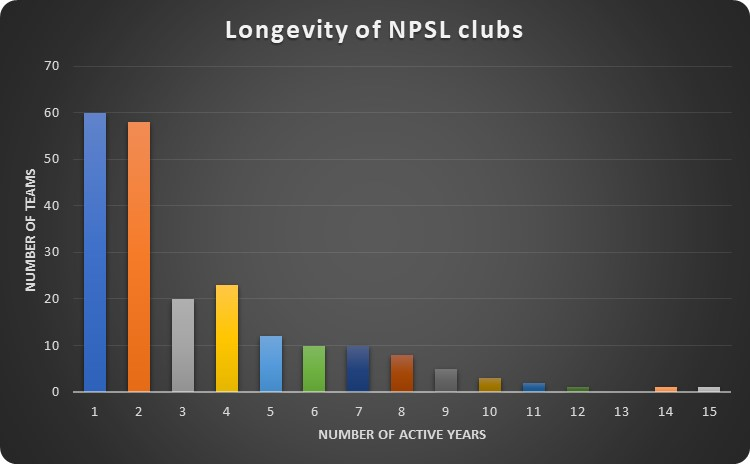
Two hundred and fourteen teams have played in the NPSL between 2003-18 with a varying degree of success and longevity (see above document and Figure 1 below). That’s a staggering number of teams. Teams that have been home to tens of thousands of adult amateur soccer players over the years. These players have provided a non-quantifiable number of memories and planted the seed for future generations of soccer players.

But, the teams themselves have a really short life span. According to our data, 81.3 percent of clubs in the NPSL operated for five years or less, and 65 percent of the 214 clubs operated for three years or less. The mean life span was 3.3 years, while the median lifespan of a club was two years.

Interestingly, certain states were home to many more clubs than others. The state of California has been home to 40 different NPSL teams (rebrands were only counted one time), which amounts to 18.7 percent of all NPSL clubs. Other states that were more prevalent were Texas with 15 teams, Florida with 13, and Michigan and New York with 11 each.

NPSL clubs

Figure 1 – Longevity of all NPSL clubs

What happened to these teams? We attempted to dig through the literature to find the reasons for the dissolution for each club. We learned that 26 teams joined other amateur leagues (with 13 joining the PDL and seven switching to the UPSL, with the remaining joining leagues such as The Premier League of America, Texas Premier Soccer League, etc).

For a majority of the clubs, however, we were unable to determine the reason for dissolution.

However, it is an open secret that financial difficulties are a component of these dissolutions. Even though costs are minimal, so is revenue. And, unlike D2 owners, who often have the dopamine-flooding-ego-reinforcing-boost of thousands of supporters turning up to each game, NPSL attendances tend to be significantly lower. In fact, an analysis by attendance guru and soccer historian Kenn Tomasch estimated that NPSL teams have an average attendance of 961 per game. And, based on what is certainly a rightward-skewing self-selection bias in the data he was sent, I would wager the actual average is lower.

As a comparison, USL attendance shill and author of the upcoming book “Eleventy Bazillion: The Indy XI Story,” Mike Pendleton, reports an average attendance of just under 5,000 fans

(Caveat:  arguably, in both cases, median attendance might be a better metric due to the skewing of data by high-attendance teams such as Detroit City and FC Cincinnati).

Therefore, owners have little to no incentive to remain in the game.

There are exceptions, of course. The oldest team in the NPSL is Sonoma County Sol (SC Sol), which has played continuously since 2004. Other clubs that reached the double-digit mark are the Minnesota Twin Stars, New York Athletic Club, Madison 56ers, Real San Jose, Erie Commodores FC and Chattanooga FC. There are 41 teams (19.2 percent) that have been active for more than five years.

Soc Takes reached out to Sonoma County Sol for comment.

From the morgue

What about the longevity of dead clubs specifically?

The above analysis may yet be biased by a recency effect — the fact that a club born in 2016-18 will over-represent the one- and two-year longevity group and, therefore, left-skew the data. In order to eliminate that bias, we analyzed a subset of the data (Figure 2) – specifically defunct NPSL clubs.

Figure 2 – Longevity of defunct NPSL clubs

We found that our general trend seems to support our earlier data. Of the clubs that went extinct, 91.5 percent did so by year five of operation. In fact, 64.5 percent of the clubs died by year two. Of the defunct clubs, the mean survival time was 2.6 years, while the median was 2 years. Unsurprisingly, the mean survival time was lower in the subset of defunct clubs. The median remained unchanged.

The polytely of solutions needed for lower-league soccer success is something we have described before. The numbers we are seeing from the NPSL and professional Division 2 data highlight the need for novel solutions imminently.

——–x———-

It turns out, regardless of whether you are investing in an amateur or professional team, your ride is likely to be a short one. With the upcoming (and in some ways much-needed) NPSL-pro option, there is clearly an issue to be addressed here. That issue is – most NPSL clubs have shown an inability to survive at the amateur level. At this level, costs are low, and so is revenue.

NPSL-Pro will have to be (1) selective, (2) Ensure that revenue generated increases at a similar rate as the expected increase in expenditure. That is theoretically obvious to anyone reading this. But, clearly, based on the graveyard of American soccer clubs, not obvious in practice.

Soc Takes reached out to NPSL for comment on this story.

Caveat: This is a significant amount of data, sourced largely on Wikipedia entries and articles from journalists. If you come across any errors, please let us know.

Soc Takes would like to thank Aran Kinwan, Ciaran Jalavin, Michael Mascilak, Mark Murray, Jeff McCollum and Soc Takes staff writer John Lenard for contributing to the data collection portion of this article.

Follow Nipun on Twitter: NipunChopra7.

Support Soc Takes on Patreon for access to exclusive content and supporter benefits. Click here to become a patron today.

The post NPSL clubs have median survival rate of 2 years appeared first on Soc Takes.

from Soc Takes https://ift.tt/2xtIXy0
via IFTTT

New on SocTakes: Supporting Local Soccer: My return to Fort Worth

Fort Worth

FORT WORTH, Texas — In the aftermath of my first Supporting Local Soccer post on the Fort Worth Vaqueros, the team and the supporters’ group both reached out to me to have me back at another game on June 16. I gladly accepted.

Tonight, I’m making my second trip to Fort Worth this month. The Vaqueros have invited me back for another game, this time in NPSL action. The Vaqueros are set to take on Katy 1895 FC in a match that has serious implications for the Vaqueros’ playoff hopes.

I’m doing things properly this time, heading out much earlier than before to join the pregame party at Magnolia Motor Lounge. This bar/restaurant is located less than half a mile north of Farrington Field, just off University Drive in Fort Worth’s West 7th neighborhood. The neighborhood is Fort Worth’s fun spot, home to a number of interesting shops, bars, and restaurants. It’s actually my first time in this area in years, having last been here on a trip to the nearby Kimbell Art Museum. Most of Fort Worth’s cultural highlights can be found within a mile radius of West 7th.

I find a parking spot that’s roughly halfway between Magnolia and Farrington. As I walk to the pay station, a woman pulls up next to me, rolls down the window and asks if I’ve paid yet. I reply that I haven’t. She then hands me a paid parking slip good through the morning. Thanks! I promise her to pay it forward later on. West 7th is absolutely packed today. I’m not surprised. It’s a Saturday evening and the weather is gorgeous.

I walk to Magnolia, and I find a handful of people with Vaqueros or other local soccer gear on. I’m in the right place. I find it unusual that I’m not carded entering the bar by the doorman. This is a first. Most people assume I’m younger than I am, and I had my wallet ready expecting to show my ID. I’ve been told that the Panther City Hellfire have my ticket tonight. I order chips and salsa, which the waitress tells me is handmade, and wait for the Hellfire to arrive. It’s objectively not bad.

The Hellfire arrive with their drums and flags ready, and take their seat outside on the patio. I grab my food and move outside to join them. I introduce myself to Nick Rainone and Jessi Foster. We start talking about the first piece I wrote, which segues into other soccer media. Nick mentions soccer podcasts, which leads to a discussion on the shows we listen to and enjoy. I mention “Front Porch Soccer” offhand, and immediately get a reaction of “I love that show!” from Nick. This is bad for my ego.

As we sit, eat and talk, I get to know a bit more about the group. It’s clear that everyone here is well-versed in lower-division soccer, and shows just how close the world of American soccer is. I mention that I’m planning to document my experiences for Soc Takes again, and I’m told to post the piece in their Facebook group once it’s finished.

At roughly 6:50, we finish eating and settle our various tabs, and begin making our way to the stadium. Someone mentions that they don’t have enough sticks for all of the drums tonight. I tell them to wait there, as I still have all of my FC Dallas gear in my car. A few minutes later, I have four pairs of good enough sticks ready for them.

The group makes its way to the corner of Morton Street and University Drive, and begins singing and drumming as they march to the stadium. I follow behind with my camera to get some pictures and video.

We walk to the end of the block and into the gates at Farrington Field. The Hellfire then take their normal position at the front of the stands, and start passing out chant sheets. Tonight, I elect to sit with them rather than wandering the stadium.

By 7:15, the stands have begun to fill. It’s already apparent that the crowd is significantly larger than last time. Easily over a thousand people here, probably not that far from two. I decide that tonight, I’m participating in the noise instead of just observing it. I gesture to a nearby drum and ask Nick, “May I?” I get a quick yes, and get to work doing what I’m most accustomed to doing at soccer games. That is, for about 10 minutes until I tear a blister on my right hand. Damn. I hand my drum back to Nick and switch to taking pictures.

Fort Worth is looking strong tonight. They’re hounding the Katy defense for much of the early minutes, when Jamie Lovegrove scores the opening goal. The Panther City Hellfire react by lighting off their blue and yellow smoke. From the restart, the Vaqueros keep the pressure on, and Kalle Masue scores a second in the 17th. More smoke ensues. Things continue in Fort Worth’s favor for the next 10 minutes. Then, while attempting to deal with a counterattack by Katy, goalkeeper Marko Jovanovic goes down in the box. This doesn’t look good. He ends up needing a cart to get off the field, and the Vaqueros have to sub in their much younger second ‘keeper Grant Makela.

Fort Worth

Fortunately for young Grant, his offense does well to keep the ball contained to the opposite end of the field for much of the half. And then, once again on a counter, Katy gets a chance in the 38th minute. It’s in, 2-1 Vaqueros now. From kickoff, Fort Worth seems bent on avenging their fallen keeper, and immediately press forward. It takes just two minutes for Masue to restore the two-goal advantage. At this point, the Hellfire have exhausted their supply of smoke, and begin singing a new song to describe their situation. “We’re all out of smoke, so we’re gonna bang on our drums all day!” The whistle blows to end the first half shortly thereafter.

At halftime, I wander over to the merch table again and find that the Hellfire are selling scarves! And they take methods of payment that aren’t strips of fabric! I quickly hand over a plastic rectangle and acquire a scarf for my collection. I also find that there’s a table set up just to sell drinks, with a selection of sodas and Jarritos beverages as well as bottled water. This table, too, accepts plastic, and I get myself a bottle of water. It’s hot, but not nearly as hot as my previous visit.

As I continue wandering the stadium, I meet Vaqueros general manager Tobias Lopez. He recognizes me, likely from the “obligatory” photo at the end of the previous piece, and thanks me for writing it. He also tells me that next season he’ll have a season ticket jersey for me so that I can come to games whenever. I do my best to express my gratitude. It means more than I can express that he read the piece and appreciated it to such a degree.

The second half begins with Katy on the attack and it takes the visitors just three minutes to score their second goal of the night. The lead is cut to one goal — for around thirty seconds. Fort Worth kicks off and rushes forward, and the first attempt at goal lands in the net. Cue the Hellfire’s song on their unfortunate lack of smoke once more.

The restart is taken, and once more it takes Fort Worth mere seconds to find yet another goal. It’s now 5-2, and this latest goal by Zachary Adler in the 50th minute seems to deflate the visitors. Their strategy shifts from pushing forward to dropping way, way back in an attempt to stop the bleeding. It works. Adler’s goal ends up being the final goal of the night for either side. This does little to dissuade the Hellfire, who continue their singing through to the final whistle.

After the game, I wind up talking with Marc Foster of the Panther City Hellfire and his son Teddy. Teddy is an unusually tech-savvy young teen, and we end up talking about my day job in corporate IT as well as gaming PCs. Marc, as it turns out, is ridiculously well connected in the local sports world as well as with American soccer as a whole. He used to work for the Brahmas hockey team back in the day and he’s even familiar with my other employers at the WPSL. We continue talking about soccer, which somehow deviates to discussing northern Michigan. His wife is from the same town as my dad, a tiny place along Lake Huron with a population of just 2,695. There’s a very good chance that my grandmother was her teacher in elementary school. Small world indeed.

I wrap up my conversation as it’s getting late and it’s a 45-minute drive home. As I’m walking back to my car, I find a car full of other youths looking for a parking space in the same lot where I parked. I grab the fully paid parking slip I received earlier and, after a brief conversation, pass it along once more. The drive home is fortunately uneventful, and when I arrive, I take a half hour to transfer my notes and pictures to my server. It’s been a fun and exhausting night.

Obligatory

I hope you enjoyed this addendum installment of Supporting Local Soccer. Be sure to check out my other pieces on the Keene FC experience, Little Rock Rangers experience and original trip to Fort Worth.

If you have a unique soccer experience you’d like to share, please let me know! My direct messages on Twitter are always open, and I’m more than happy to make a trip out to support local soccer.

If you, somehow, need more of my nonsense in your daily life, please follow me on Twitter and Instagram, where I’m @JohnMLTX. And as always, thanks for reading.

Support Soc Takes on Patreon for access to exclusive content and supporter benefits. Click here to become a patron today.

The post Supporting Local Soccer: My return to Fort Worth appeared first on Soc Takes.

from Soc Takes https://ift.tt/2Mfo9P5
via IFTTT

New on SocTakes: USL playoff race in Week 26


USL playoff race

Toronto FC II is on the brink of being eliminated from playoff contention. Photo credit: Robbie Mehling/ Soc Takes

The USL season has passed the 75 percent point and we’re into the final weeks of the season. That means the playoff race is heating up!

And yet, because of the sheer madness that is the USL, no team has been eliminated from the playoffs yet, and only one team has secured a spot.

First up, FC Cincinnati is the only team at this point to have secured a spot in the postseason. Cincy is sitting on 60 points in 27 games (a ludicrous 2.22 PPG!), which means that only seven teams can pass them. While it’s a safe bet to expect Cincinnati to finish top of not just the Eastern Conference but the league as a whole, its seeding is still very much undecided.

As for the rest of the league, no one can clinch this week. Yeah, Cincinnati is that good.


And now onto the elimination scenarios for Week 26, beginning in the Western Conference.

Tulsa Roughnecks FC currently sits at the bottom of the West and is the closest team to elimination in the conference. There are four different scenarios that will see Tulsa eliminated by the end of the week:

  1. Tulsa loses/draws against Sounders 2 on Wednesday; San Antonio wins/draws against Phoenix on Saturday
  2. Tulsa loses/draws against Sounders 2; Saint Louis wins against Reno on Saturday
  3. Reno wins against Saint Louis; San Antonio wins against Phoenix
  4. Tulsa loses/draws against Sounders 2; Tulsa loses/draws against Timbers 2 on Sunday

Tulsa essentially needs to win out the season and hope for a lot of dropped points to even have a shot at making the playoffs.

In the East, there’s one team facing elimination this weekend, Toronto FC II. TFC II is also at the bottom of its conference with 12 points from 25 games. There are three scenarios for TFC II’s elimination:

  1. TFC II loses/draws against Ottawa on Wednesday
  2. Nashville SC wins against North Carolina on Saturday
  3. TFC II draws against Ottawa; Nashville draws against North Carolina

That’s all for this week in the USL playoff race. Stay tuned for the next report which should be out next Monday and will continue until the final seeding is determined. In the USL, that can mean literally the last day of the season!

As always, thanks for reading and thanks for supporting Soc Takes. Apologies for the delay in the Q3 progress report. Lots of life suddenly happened, and rather than a 75 percent report, it’ll be closer to 80 percent-ish. It’s coming soon!

Follow John on Twitter: @JohnMLTX.

Support Soc Takes on Patreon for access to exclusive content and supporter benefits. Click here to become a patron today.

The post USL playoff race in Week 26 appeared first on Soc Takes.

from Soc Takes https://ift.tt/2PCcXhN
via IFTTT

New on SocTakes: Canadian Premier League primer

Canadian Premier League

Image credit: Canadian Premier League

Canada has announced that, at long last, the country is building a national, professional, Division I league of its own. Here’s everything we know so far about the league, the teams announced for next season and how the league will operate.

First up, the league itself. The Canadian Premier League will be the top league sanctioned by the Canadian Soccer Association, equivalent within their pyramid to MLS. Canada Soccer made the decision on May 6, 2017, and the league plans to begin play in the spring of 2019. There will almost certainly be eight teams playing at launch, with the slight possibility of 10 should a few more pieces fall into place sooner. So far, though, seven teams have been officially announced.

We’ll go through the seven officially announced teams first, in order of announcement:

York 9 FC – York Region, Ontario

  • Home stadium: York Lions Stadium (3,700)
  • Head coach: Jimmy Brennan
  • Colours: electric green, charcoal grey, black on black

York 9 was the first team to be announced, representing York Region in the greater Toronto area. The name is a reference to the nine cities and towns that constitute York Region, as well as the attacking No. 9 player. York’s choice of green is based on the forests throughout the municipality and the ownership by Greenpark Group. The team will play initially at York Lions Stadium on the York University campus, and is planning a 15,000-seat soccer stadium with a unique wooden construction. Head coach, general manager and co-owner Jimmy Brennan is a York native who played in England as well as MLS, received 49 caps for Canada and coached in both League 1 Ontario and the Toronto FC Academy system.

Cavalry FC – Calgary, Alberta

  • Home stadium: Spruce Meadows (5,000)
  • Head coach: Tommy Wheeldon Jr.
  • Colours: army green, Calgary red, black on black

Calgary’s Cavalry FC was the second team to be announced. This team is, to a decent extent, an offshoot of the PDL Calgary Foothills FC team, with general manager and head coach Tommy Wheeldon Jr. having spent the past five seasons with the PDL side. The name and colours are directly inspired by the Lord Strathcona’s Horse regiment of the Canadian Army with strong ties to Alberta and Calgary. The team will be playing in a brand-new stadium at the famous Spruce Meadows equestrian facility. The stadium is currently expected to seat 5,000 in a natural grass, modular facility, allowing for potential expansion in the future.

HFX Wanderers FC – Halifax, Nova Scotia

  • Home stadium: Wanderers Grounds (5,000)
  • Head coach: Stephen Hart
  • Colours: harbour blue, naval grey, aqua ocean

The Wanderers are playing up the maritime aspects in a big way, for obvious reasons. The colours and crest all draw heavy coastal symbolism, and the club motto is in Scottish Gaelic, incorporating the strong local Gaelic ties. As the largest city on Canada’s Atlantic coast, the harbour has been a vital part of Halifax since the city’s beginning. The name itself, “Wanderers,” is an homage to the Wanderers Amateur Athletic Club which operated for a century from 1882. The club will play at the Wanderers Grounds, home to the former Wanderers, in a new 5,000-seat stadium similar to the plans in Calgary. Head coach Stephen Hart, despite his Trinidadian citizenship and international status, is a fixture of soccer in Nova Scotia and has been for decades. He has also spent the better part of the past 20 years with the Canadian national programs.

Valour FC – Winnipeg, Manitoba

  • Home stadium: Investors Group Field (33,234)
  • Head coach: Rob Gale
  • Colours: valour maroon, wheat gold, earth black

Valour FC is the first announced team which intends to share ownership and a stadium with a Canadian Football League team, in this case the Winnipeg Blue Bombers. The Valour name is tied to Valour Road in Winnipeg, dedicated in 1925 to a trio of residents who received the Victoria Cross for acts of bravery in World War I. The maroon in the crest comes directly from the ribbon on the Victoria Cross, while wheat gold and earth black tie in to the Canadian prairies. The design in the middle includes both a combination V/W shape for Valour and Winnipeg, while the circle design is taken from the Victoria Cross. Head coach and general manager Rob Gale played amateur soccer in Winnipeg for a decade and has coached the Canadian youth international teams at the U16, U18 and U20 levels.

FC Edmonton – Edmonton, Alberta

  • Home stadium: Clarke Stadium (5,000)
  • Head coach: Jeff Paulus
  • Colours: prairie blue sky, River City navy, white rabbit

FC Edmonton is actually the oldest team in the CPL, dating back to 2009, having played in the NASL from 2011-17. The professional side was shut down at the end of the 2017 NASL season due to uncertainty with the league’s future and a lack of viable options for 2018, but the club planned to restart a professional team at some point in the future. Enter the CPL, and of course, FC Edmonton is back with a new logo and head coach. Jeff Paulus has been with the FC Edmonton organization since 2011 as academy technical director and an assistant with the NASL first team. He’s now been appointed head coach of the reborn professional side under general manager Jay Ball. Clarke Stadium is expected to undergo some upgrades to build permanent locker rooms on-site and expand the seating to 7,000.

Forge FC – Hamilton, Ontario

  • Home stadium: Tim Hortons Field (14,000)
  • Head coach: TBA
  • Colours: spark orange, platinum steel, waterfall white

Hamilton was one of the first two teams initially approved, along with Winnipeg. The club’s branding is heavily inspired by Hamilton’s long history in steel manufacturing dating back over a century. Forge FC is another team that shares ownership with the local CFL side, in this case the Hamilton Tiger-Cats’ Bob Young. For Forge FC games, Tim Hortons Field will have its capacity reduced by covering the top stands on both sidelines. Club vice chairman John McGrane is a former Canadian international who coached the Hamilton Steelers in the Canadian Soccer League in 1988, 1989 and 1991. The club has yet to announce a head coach or general manager.

Pacific FC – Langford, British Columbia

  • Home stadium: Westhills Stadium (7,500)
  • Head coach: Michael Silberbauer
  • Colours: starfish purple, lagoon blue, lighthouse white

The most recent club to be announced is Pacific FC, based on Vancouver Island. The club’s branding is inspired by the island, incorporating the native Douglas fir tree and shape of the island itself. The stadium is set to undergo renovations to increase the capacity through temporary modular pieces, and will eventually be replaced by a permanent expanded stadium. Head coach Michael Silberbauer is the only non-Canadian coach in the league. He’s a retired Danish international currently working as an assistant coach with FC Luzern in Switzerland. Club president Josh Simpson is a retired Canadian international from mainland British Columbia. The club is intended to represent Vancouver Island as a whole rather than any particular city.

Those seven are all officially confirmed for next year. The Ottawa Fury are expected to join them following the conclusion of the 2018 USL season and discussions are ongoing involving possible teams in Moncton, Saskatchewan, Quebec and Mississauga. Despite those conversations, though, it’s widely expected that the league will feature eight teams in 2019 and 12 in 2020. Each team will play 28 games — 14 at home — in 2019, playing each of the other seven teams four times.

For the rosters, the league will be operating under a salary cap for both the players and coaching staffs. The average player salaries are expected to fall between $40,000-$60,000. Every club must field a minimum of six Canadian players at any give time during a game, and at least half of the roster must be Canadian.

Players will come from five player pools:

  1. Foundational: professional Canadian players already playing “at a high level”

  2. Up and coming: players in developmental leagues, including League 1 Ontario, the PDL, and lower-division leagues internationally

  3. Home territory: players from the surrounding community of each club, comparable to the MLS Homegrown system

  4. Canadian universities and colleges: likely a draft of U Sports players

  5. Open market: Players signed from anywhere, without restriction on nationality

There will likely be some sort of draft for pool Nos. 1, 2 and 4, although league officials have described it as “more sophisticated” than a typical player draft.

That’s all we know at present about the Canadian Premier League. News of the eighth team — or just confirmation from Ottawa — is expected before the end of the year and player signings will begin early next year. The schedule is expected to run from April into October, potentially without playoffs. Media deals have yet to be announced, but are expected to include streaming options.

Follow John on Twitter: @JohnMLTX.

Support Soc Takes on Patreon for access to exclusive content and supporter benefits. Click here to become a patron today.

The post Canadian Premier League primer appeared first on Soc Takes.

from Soc Takes https://ift.tt/2BKrfuL
via IFTTT

New on SocTakes: Supporting Local Soccer: My trip to Little Rock

Little Rock Rangers

Image credit: John Lenard/Soc Takes

LITTLE ROCK, Ark. — My third “Supporting Local Soccer” adventure takes me on the farthest trip yet: 338 miles and roughly five hours northeast from Dallas to Little Rock. I’m here to check out the Little Rock Rangers’ season-ending doubleheader.

This trip technically began back in November 2017. I was sitting around in Inkscape, as I typically spend my free time, and I ended up with an idea for a soccer flag for the Little Rock Rangers. On the ninth of that month, I tweeted that flag design and tagged both the team and the supporters’ group, the Red Watch. We kept talking via Twitter, which eventually led to Red Watch founder Ryan inviting me to Little Rock to catch a game. The game in question is actually two games, a season ending double-header. The WPSL side is set to play Oklahoma City FC, while the men’s team is taking on Tulsa Athletic. With the schedule arranged, it’s time for me to plan my trip.

This is by far the farthest I’ve ever traveled explicitly for a soccer game. It’s 345 miles from my house in North Texas to War Memorial Stadium in Little Rock. That’s a five-hour and 15-minute drive. My plan is to leave Saturday morning, grab something to eat along the way, stop at the hotel to unpack and unwind before the game, then head to the stadium. After the game, I plan to crash at the hotel and drive home in the morning.

Saturday morning comes and I’m packed for my trip. I’m traveling light; only taking a basic change of clothing, my computer, and the necessary cables and chargers that usually stay inside my bag. I’m not planning to spend a lot of time at the hotel beyond sleeping. I get in the car around 8 a.m. and start heading east. I’ve made this drive from Dallas to Little Rock at least a dozen times before, so I’m pretty comfortable with the route. Basically, just drive southeast until I hit I-30, then drive until I’m in downtown Little Rock. It always amuses me when my GPS app shows something like “continue on I-30 E for 290 miles”.

My first stop of the morning is in Rockwall, which is about 45 minutes into the trip. I stop for breakfast and fuel, and sit to watch the morning’s World Cup action. On the morning in question, Sweden and England are playing. I sit for around a half hour to eat and relax before getting back in the car and back on the highway.

From there, I don’t stop again until I’m in Little Rock at my hotel. I check in, unpack a bit and watch the remainder of Russia vs. Croatia. I text Ryan and ask about any pregame activities. He informs me that there’s nothing planned for today, but that there’s an excellent restaurant down the street from the stadium that I should try. The place is called “Big Orange Burger,” and the chicken sandwich I order is wonderful. From there, I drive the half mile to the stadium.

The Rangers play at War Memorial Stadium in Little Rock, a venue I’ve actually been to several times before for college football. It’s the second-largest stadium in the state, seating a whopping 54,120. Ryan has arranged press credentials for me for the day, giving me access to the entire facility. I meet a friend from Reddit, Ben, and we head into the stands. This stadium really is massive. It was renovated not long ago, and it definitely feels like a Division I college football venue. Maybe it’s the stadium, maybe it’s the team itself, but my initial impression walking in is that this feels professional.

If there is a criticism to make of War Memorial Stadium, it’s that the markings on the field indicate the primary purpose. There’s a football gridiron, thick white lines, bold “ARKANSAS” lettering in the end zones and all. The soccer markings are done in yellow, and look weather-worn and somewhat faded. They’re not the easiest to see. On that point, though, there may be some good news in the near future for the Rangers. There have been rumors saying that the stadium will undergo additional renovations with soccer as a focus, and the Little Rock Rangers would be considered a primary tenant.

The first game of the day is the WPSL game between Little Rock and Oklahoma City FC. Oklahoma City is a veteran of the league and one of the strongest teams in the Central Region. Little Rock isn’t. Quite simply, they just don’t have the same depth, and their roster is much younger and less experienced. It shows. OKC scores in the eighth minute. And then again in the 19th. And then again in the 25th. Little Rock is able to maintain that 3-0 scoreline through to halftime, but four minutes into the second half, OKC scores a fourth. A minute later, they score a fifth. The next 26 minutes see Little Rock looking its best, and they have a few threatening moments on the other end. That is, until OKC scores a sixth on the counter in the 76th minute. It’s a bit back and forth for the final fifteen minutes, but Little Rock only has one good shot that’s saved.

After the first game, I get up to wander around, check out the press box and investigate the various concession and merchandise booths in the stadium. I pick up a scarf and Ben buys me a beer from a local brewery. It’s a Bluewing blueberry wheat ale from Flyway. I’m not normally much for beer, but this is objectively not bad. For the second game, Ben and I join Ryan and the rest of the Red Watch to get the full local supporters’ experience. Ryan picks up a flagpole off the ground to show me. It’s my flag. I’ve seen the pictures on Twitter, but there’s something really surreal and incredible about seeing one of my creations made real. I grab an obligatory selfie with the flag, and legitimately consider signing it for a moment.

The Red Watch has a dozen or so members here tonight for the game. Ryan hands everyone present some streamers and a red Enola Gaye smoke grenade. This is my first time holding such a device and I can’t hide my excitement. Ryan also hands me a Red Watch scarf and it has that inky, new-scarf smell. The Red Watch is full of interesting and delightful characters, and we instantly hit it off. I’m surprised to find myself surprised at how tied in they all are to lower-division American soccer. It’s wonderful.

This second game is a bit of a big deal. Little Rock is looking to secure a home playoff game for the first time in club history, and all they need to do tonight is win. Tulsa Athletic, meanwhile, has a chance to spoil the party and force the Rangers to travel to Oklahoma for the first round of the playoffs. The two clubs sit level on points with identical 6-3-0 records, just below FC Wichita.

I’m informed by the Red Watch members that this is definitely a rivalry. Tulsa and Little Rock have been playing each other since Little Rock joined the NPSL in 2016, and Little Rock has never won. The previous encounter between the two was a particularly ugly affair: Tulsa won at home 6-1. That blowout actually stands as the worst loss ever suffered by the Rangers. Tonight, they’re definitely out for revenge.

From kickoff, it’s chippy. Both teams have received a yellow card by the 20th minute. Every challenge is rough and physical. This is undeniably a rivalry, and every player knows it. The Red Watch responds by going nuts, making noise, banging drums and singing loud enough to get half the stadium involved. There might only be a dozen of them, but it’s absolutely plenty to feel like a party.

The crowd at large is definitely not bad, and there must be at least 2,000 people in the stands. I’m comparing this mentally to the game I attended in Fort Worth, and while it’s a tough call to say which crowd is larger, I’m giving the advantage to Little Rock. I shouldn’t be surprised given what I already knew about the club, but any team that manages to get that many people to an amateur soccer game in Arkansas is doing so many things right.

Back to the game. It’s now late in the first half and Little Rock is still out for blood. Somehow, this game is still scoreless, thanks in no small part to minor heroics from Tulsa’s goalkeeper. The first half ends without much additional faffery, and I use the halftime break to socialize with my fellow soccer crazies.

The second half begins with much of the same ongoing stalemate that marked the first. Both sides have their moments, but nothing particularly dramatic happens for the first 20 minutes of the second half. In the 65th minute, yellow cards are handed out to Little Rock’s Daishi Uekuri and Tulsa’s Adam Habib. These work a fair bit to calm both sides down for 10 minutes or so. The ball goes out for an Athletics corner in the 79th minute. After a minor skirmish in the box, Little Rock’s keeper makes a save, punts the ball 70 yards down the field and right to a charging Alex Guadron. He shakes three defenders, takes a shot from 12 yards out and scores.

Everyone goes nuts. Smoke grenades, drumming, streamers, screaming. The entire team comes over to celebrate right in front of the supporters. The kickoff is taken, and the Little Rock players push forward immediately. Tulsa is forced to bunker and counter for the first minute or so. And then, Adam Habib gets a second yellow for a clumsy challenge along the sideline. Little Rock now has a goal and man advantage, and 10 minutes to keep the lead. Easy.

From then on, Little Rock is clearly in full control of the game. Tulsa looks tired and they’re having a hard time keeping up while shorthanded. It only takes Little Rock nine minutes to score a second, and it’s a gorgeous chip from 10 yards out. This time, Tulsa’s ‘keeper actually gets a hand on it, but it slips through his arms into the net. Cue a second round of celebratory chaos.

One of the team staffers on the sideline walks over to the supporters and starts discussing something I never expected. We’re going onto the field. All of us. We watch the final few minutes of stoppage time from field level. It feels like an eternity. The final whistle blows and we storm the field. I run out to midfield, then drop back, pull my phone out and start recording. This is such a surreal experience. I’m high-fiving players and shaking hands. Everyone is standing and cheering.

Security gives us five minutes to celebrate before retrieving us from the field. I take a few minutes to chat with my new Arkansan soccer friends before heading out of the stadium and back to my hotel. What a night. I take a half hour or so to document my thoughts before heading to bed.

The next day, I wake up reasonably early, make a quick vlog about my trip and hit the road. It’s a nice, uneventful drive home.

The following Wednesday, Little Rock hosts its first home playoff game in club history, a rematch against Tulsa. The home side wins 1-0 with the lone goal coming in the 90th minute. Little Rock moves on to the Heartland Conference Final, where they face a dominant FC Wichita team. Little Rock manages to hold Wichita scoreless for 90 minutes, holds strong as the match goes to extra time and forces a penalty shootout. Andres Ochoa misses the third penalty for Wichita. Little Rock doesn’t miss any. The Rangers move on to the South Region semifinals, traveling all the way to Texas to play the Laredo Heat. The game is tied 1-1 after 90. Little Rock’s Donald Benamna, the hero from the first playoff game, scores in the 115th to send the Rangers to the South Region finals. Their opponent? Miami FC 2.

The game in Miami isn’t much of a fair matchup, given what Miami FC did to the rest of the NASL in 2017. Little Rock’s playoff journey ends with a 3-0 loss far away from home, but it’s still their best season ever. And my friend Ben, who I invited to the game? He caught the local soccer bug hard, and is now well integrated with both the Red Watch and the Rangers team.

Thanks for reading the third installment in “Supporting Local Soccer.” I hope you enjoyed this piece as much as I enjoyed my trip. If you have a unique local soccer experience you’d like to share, reach out to me on Twitter. If you haven’t read the previous installments yet, check them out here and here.

Follow John on Twitter: @JohnMLTX.

Support Soc Takes on Patreon for access to exclusive content and supporter benefits. Click here to become a patron today.

The post Supporting Local Soccer: My trip to Little Rock appeared first on Soc Takes.

from Soc Takes https://ift.tt/2wdybLI
via IFTTT

New on SocTakes: Improving MLS All-Star week

MLS All-Star week

Photo credit: John Lenard/Soc Takes

ATLANTA — Ah, All-Star week. That time of year when we get to watch a team of MLS star players take on some international powerhouse club, while the up-and-coming Homegrown stars play some major club’s youth team. It’s all a great time, and a great opportunity for MLS fans around the USA and Canada to congregate in one place.

However, it’s not nearly as fun as it could be, nor as fun as it should be. Let’s fix that, shall we?

But first, as is customary, a history lesson.

The All-Star Game has been an annual fixture of the MLS season since 1996. The first two years pitted East vs. West, akin to the other four major American sports leagues. For 1998, MLS adopted a USA vs. the World format, pitting two teams of league all-stars against each other; one comprising American players, the other foreign. The East vs. West format returned in 1999 (despite MLS adopting a third division, the Central Division for the 2000 and 2001 seasons) and continued until 2002, when MLS switched to the first All-Stars vs. guest format. That first game saw the MLS All-Stars taking on the U.S. men’s national team (though, considering full USA internationals Jason Kreis and Steve Ralston scored for MLS, I’m calling shenanigans). The first All-Stars vs. foreign club game was the 2003 edition, when the All-Stars hosted CD Guadalajara at the brand-new Home Depot Center. Following a one-off return to East vs. West in 2004, the All-Stars have taken on an international club in every subsequent game.

Why, exactly, am I so concerned with fun? Because throwing together the best and most popular players in a league or conference and seeing what they do together is just delightful. Want to see Zlatan, Tim Howard, Carlos Vela, Miguel Ibarra, and Diego Valeri as teammates on the field together? Hell yeah I do. It’s not going to be high-quality soccer, that’s a given. Great teams are great because of things like team chemistry and familiarity on the field. The All-Stars never have that, nor should it be expected. They’re there to go have fun together for our and their enjoyment. That’s beautiful.

MLS All-Star week

Photo credit: John Lenard/Soc Takes

So, here’s the first proposal: bring back the East vs. West All-Star Game. While it’s definitely fun watching our league’s best take on European giants, those invited clubs generally treat the game as part of preseason training. International superstars aren’t likely to push themselves too hard, as going down injured in what is essentially a preseason friendly could cost them a starting spot. It just doesn’t make sense for those teams to try and play with the same intensity as they would in league play. Meanwhile, the East vs. West games averaged nine goals scored per game, and players generally played out of their minds. That’s both more fun and more relevant to fans of MLS.

So, East vs. West. That’s one fix. Let’s also take that format and apply it to the Homegrown Game, where we get to see a full 90 minutes of pure homegrown talent. For one, it gets these young players in front of a lot of eyeballs, and for two, it’s a contextually relevant game both in terms of MLS experience and youth national team experience.

Onto the rest of All-Star week. Let’s bring in a skills competition. Why not? It’s always great fun watching NHL players do crazy stuff every year, and the Home Run Derby is a borderline religious experience in the Church of the Almighty Dong. And there are a number of relevant skills competitions we could have in the All-Star Game. Here are four ideas I have already:

1. The 35-yard shootout

Back in early MLS, games never ended in draws. If both sides were level after 90 minutes, games went to a shootout. Here’s a video so you can see what I mean:

Players started 35 yards from goal, and had five seconds to beat the goalkeeper. Keepers were able to come forward and defend, while kickers got to dribble up the field and prepare a shot. They’re wildly entertaining to watch even today. Compare these to the very similar shootouts in hockey. Let’s turn this into one of our skills. Take the starting ‘keeper from each conference’s All-Stars, and put them against maybe four or eight field players from the other conference. And if a defender or even a ‘keeper wants to give it a go, that’s even better. Hell, if Zlatan wants to play in goal and Luis Robles wants to try and score on him, let that happen. I’ve been — quite loudly — arguing for these shootouts to supplant penalty shootouts in MLS and the U.S. Open Cup for years. If that dream is to ever become a reality, we need more people to learn or remember just how great those 35-yard shootouts are.

2. Long-range bombs

We all love a ridiculous strike from midfield that flies over the ‘keeper’s head and into the back of the net. If we didn’t, those goals wouldn’t win Goal of the Week every time they happened. And if you think you don’t like those goals, watch this video right here:

That should change your mind. Ever wonder who’s the best at that? Well I certainly have. Let’s find out together. Get some great players to take the shot, and have a designated keeper and defender to try and keep it out of the net. Shooters stand from the long end of the half-way line, run up to the ball, and just blast that sucker at the goal. This would be MLS’ Home Run Derby.

3. Crossbar challenge

It seems like everyone’s doing one of these nowadays, so what the hell, welcome to the Skills Competition. If you’re unfamiliar, the crossbar challenge is a sort of free kick competition wherein the goal is to hit the crossbar instead of the back of the net. It’s a bit odd, and definitely confusing to watch if you don’t know what’s going on, but it’s also good fun. The players seem to enjoy it, too, and there are dozens of videos of prominent players giving it a go.

4. Trick shot challenge

Again, why not? Partially suggested by my friend Valerie, and definitely inspired by hockey. Let players try and score a goal in whatever ridiculous way they please. Props? Yes. Inviting whomever onto the field to assist? Yes. In the NHL, this turned into a big chaotic mess, and it was delightful. They’ve since introduced measures to restore normality in all the wrong ways, so let’s have their fun for them.

At this point, I think I’ve made enough of a case. MLS All-Star week could be way more weird and entertaining than it is currently, and in conclusion, I should be in charge. Thank you and goodnight.

Follow John on Twitter: @JohnMLTX.

Support Soc Takes on Patreon for access to exclusive content and supporter benefits. Click here to become a patron today.

The post Improving MLS All-Star week appeared first on Soc Takes.

from Soc Takes https://ift.tt/2LWkPfJ
via IFTTT

New on SocTakes: New league announced: US Premiership

US Premiership

Image credit: US Premiership

On July 30, the US Premiership officially launched via a pair of Facebook posts. The first was a bit light on information, but the second revealed that the organization has purchased the Texas Premier Soccer League, a semi-pro league affiliated with US Club Soccer, and that the owner and head coach of the Bay Area Hurricanes (based in Houston) is serving as South Texas Regional Commissioner, although this is somewhat unclear in the post.

Additional research by Beau Dure on Twitter indicates a partnership with the American Soccer League, an eight-team league based in the northeast. A cursory check shows that the American Soccer League website and the US Premiership website are on the same server and running the same Soccer Max engine. In a brief phone call with the league, we learned that the US Premiership is owned by Soccer Max Websites, a content management system for soccer teams and leagues based in Port St. Lucie, Fla. Information on two teams can be found on the American Soccer League website at present: Miami United FC, which played in the NPSL in 2018; and Miami Soccer Academy. Neither of those teams have ever played in the ASL, and Miami United CEO Roberto Sacca has no knowledge of the US Premiership. Curiously, Miami United is found in one of three news posts on the US Premiership site, which raises further questions.

I’ve reached out to Soccer Max Websites for additional info which will be shared as it arrives.

Thanks to American Pyramid Blog where we learned of this story on Twitter.

Follow John on Twitter: @JohnMLTX.

Support Soc Takes on Patreon for access to exclusive content and supporter benefits. Click here to become a patron today.

The post New league announced: US Premiership appeared first on Soc Takes.

from Soc Takes https://ift.tt/2vrUWtT
via IFTTT